SGD/INR – Has anything really changed??


Its been almost a year since I wrote anything on SGD INR or for that matter anything else. With the rate hovering around 35 there have been quite a few requests for me to express my views and here is my opinion.

How has the Past Analysis fared?

In my last post  (10th May 2010) I had recommended that converting SGD to INR at 33+ mark as it is beneficial based on Interest Rate Parity:

  1. Interest Rate on secured deposits  in India was 8% or more making conversion attractive and
  2.  The expectation was a downward movement from then rate of 32.4 against one SGD to Rs.30 giving additional gains

The first part of analysis held good but the rate moved opposite  – towards the Rs. 35 mark.

The instant question that comes to mind is Did I lose if I converted to INR instead of holding SGD’s?

The answer is NO. As per recommendation the pair moved to 33.29 within 2 weeks of recommendation on 21 May 2010. One Dollar coverted to INR @ 33.29 for 1 year and invested @ 8% would grow to 35.95 which is less than todays interbank rate of 35.85

Whats the recommendation for upcoming months?

I am going to stick with my recommendation that converting SGD to INR is beneficial in all situations and one would not loose by repartriating money to India and parking in fixed deposits.

The Interest Rates have strenghthened to 9.5% as of today and conversion has become even more attractive. To substantiate – lets say we convert 1 SGD @ 35.85  now and invest @ 9.5%, it will grow to 39.25 in one years time. Would SGD INR touch 39.25 in one year? Unlikely!!

SGD INR rate is a cross between USD-INR and USD-SGD for which the current rate is 44.25 and 1.235 respectively. For SGD INR to fetch 39.25 in a year the USD-SGD would have to move to 1.13, assuming that there is no change to USD INR.

Consensus on the street is that USD-SGD could move up to 1.19 by October 2011. Even if INR weakens to 46 against the USD the possible rate would be  38.65 after a year which is lesser than what you get by investing in a Fixed Deposit.

How do I decide when is a good time to convert?

Exchange rates do not move linearly and with the volatility its difficult to know if its a good time to convert. Also at the request of few readers I have added the dimension of taxability of interest income @ 30%. The below graph shows the movement of SGD INR for the past 2 years.
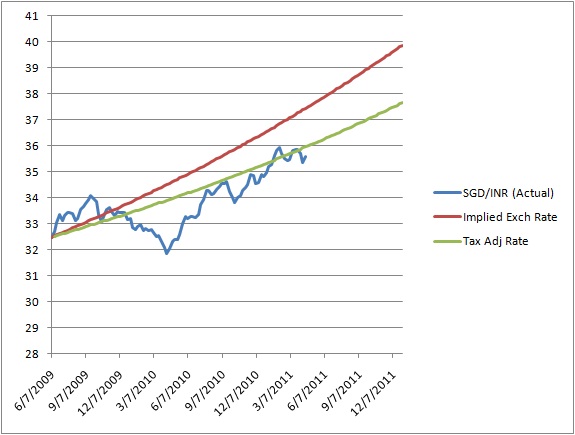
Two important observations are:

  1. SGD INR has stayed below the Tax Adjusted Implied Rate (TAIR) line except 2 occasions
  2. Its beneficial to convert to INR whenever the actual rate moves away positively from the TAIR.

On 13 Sep 2009 the TAIR was 32.94 and Actual Rate was 33.94, Actual Rate moved back to TAIR of 33.01 on 4 Oct 2009. On 30 Jan 2011 the Actual Rate was 35.81 against the TAIR of 35.49 and the two converged to 35.53 by 6 Feb 2011.

The chart below shows the prediction based on curent exchange rate of 35.85, Interest rate of 8.5% till 30 June 2011 and 9% after that till 31 Dec 2011, tax of 30% and Start of Year Rate of 34.96:
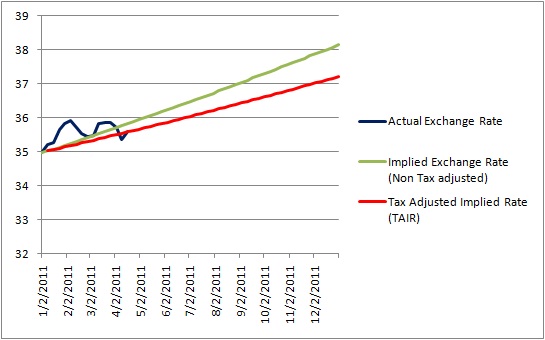
 

The expectation is that with the Singapore elections on 7 May 2011 the SGD might appreciate quickly towards 1.19 against the USD giving a possible rate of 36.5 in next 2 weeks. If this happens you know what to do!!

———————————————————————————————————————————————


Update – 30 May 2011

The Interbank Rate moved up to 36.55 today – target achieved. There is a slight possibility of the pair flirting with 37 levels but 36.5 is a good rate to convert.
 

SGD INR – Volatile Times Ahead

A quarter of the year has passed since I last wrote about SGD INR and it is satisfying to see the analysis going right – the pair dropped below 32 in the first quarter.

I did not realise that I happened to be one of the few who write about the pair and recently a lot of people have been asking my views on the pair given the new financial turmoil stirring up on the horizon.

Before going into details lets enumerate the factor variables and conflicting forces active at this point in time.

  1. The Euro precipitation due to crisis in Greece.
  2. Flight from Emerging Market investments as a risk aversion
  3. MAS’s decision to let SGD appreciate against the basket of currencies to reign in inflation
  4. China’s indication on letting Yuan strengthen
  5. Recovery in US economy and its impact on USD.

Add to it that SGD INR is a cross pair determined by movements of SGD/USD and USD/INR.

USD/INR

USD/INR dropped below the mark of 44 a few days back and has since sharply recovered. The long term mean for the pair has been the 44-45 mark with fluctuations of Rs.5 either side. The pair would continue to strengthen as the Indian economy grow and there is Foreign Direct Investment. With the greece crisis stirring up there is bound to be some profit taking in the Indian markets by FII and flight of capital outside India. This would result the pair moving towards the 46.0 mark as a knee jerk reaction.

Further more with EUR depreciating the USD – there will be added strength to USD which would indirectly work in favour of USD/INR marching upwards.

However with Yuan appreciating against the USD some of the USD strength against all currencies would be negated. 

SGD/USD

This one is a more complicated pair to analyse. The singapore economy has shown good growth in the first quarter and the pair has gradually strengthened to below 1.40 levels. The MAS has shown intent to let the SGD appreciate against a basket of currencies.

No one knows for sure what is the composition of this basket – but USD and EUR definetely are larger components. There is a posibility that Yuan might be added to this basket if not already a part of it or get a bigger weightage if its already there.

With currency appreciation a way to reign in inflation the pair might edge back to 1.35 though this movement would be gradual. On the flip side a strong currency makes exports cheaper for Singapore – both services and manufacturing and government might still want it to hover around sub 1.39 mark.

How the 2 impact SGD/INR?

Now with USD/INR looking to touch 46.0 and SGD/USD moving around 1.375 (taking mid point between 1.35 and 1.40) mark the cross rate would be 33.45 – with a lower and upper range of 32.80 ~ 34.07

I would recommend this retracement to convert SGD to INR before the long term trend of a march towards 30 resumes.

SGD INR – whats in store for 2010

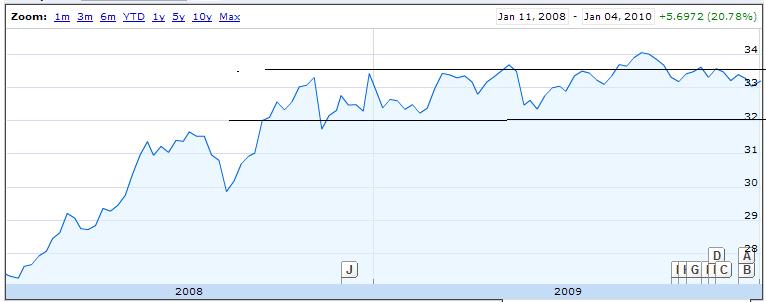
2009 proved to be a volatile year for a lot of currencies – specially the pairs with USD as one of the component, but the cross currency rates like SGD/INR showed relative stability. The pair has moved between 32 and 33.5 over the past 2 years.

The question a lot of you would be asking is what happens in 2010? So here is my analysis.

I expect SGD/INR to turn towards 32 to 30 range over the next 6 months to a year. A look at the chart below would show that the pair failed to stay past 34 mark even though it crossed it once. The pair has been hovering betwen the 33 – 33.5 mark for past 6 months. 


SGD-USD movement

The Singapore Monetary authority has been maintaining a policy of gradual appreciation of SGD against the USD. This has been giving SGD strength against the INR as well (SGD/INR) being a cross rate.  The latest economic data shows that the Singapore GDP shrank by 6.8% in Q42009. This would force the MAS to rethink about the strong SGD approach. The most likely scenario is for SGD to move to the 1.45 – 1.50 range against the USD. traditionaly the MAS has allowed SGD to strenthen against basket of currencies with growth in SGD.

INR-USD movement

Indian economy on the other hand has been performing well and the projected growth in GDP is 6.5 to 7.5%. With improving GDP numbers and growth in economy the INR should strenthen back to its long term mean of 44 – 45 against the dollar. Using these two assumptions we can plot the projected move of INR against SGD.

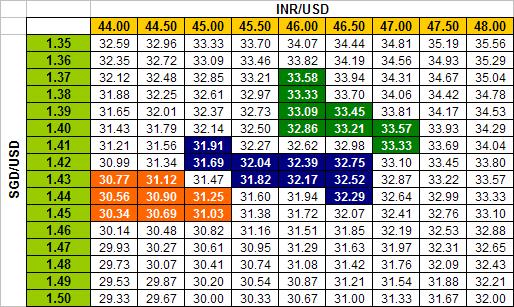
Cross Rates between SGD/INR based on possible values of SGD/USD and INR/USD

The cells in dark green indicate the current range of SGD-INR depending on the rates of SGD and INR against the USD.

The cells in dark blue indicate the possible rates as the currencies re-adjust giving a range of 31.9 to 32.75 (this is the short term expectation – for next 3 to 6 months)

The cell is amber indicate the longish term range as the growth gathers steam over next 1 year.

So as always – I would recommend converting converting SGD to INR at any rate above Rs.33 for a Singapore dollar.

Go Long on USD/JPY @ 88.00

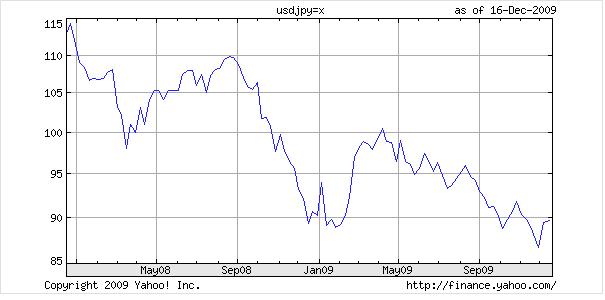
At the time of writting USD/JPY is trading at 88.06 after having tested 86 in the past few days. There is a general concern of yen stregnthening further but I would place my bets other way round.

My recommendation is to but USD/JPY in two tranches. first one now at 88 and again if it drops around 86. There should be a quick bounce back to 90 giving around a 3 – 5 % gain.

Over the next 3 months USD/JPY should make a move towards 93-95 range.

Detailed analysis

The USD JPY chart below shows that the pair is trading near its 2 years lows. From a pure technical perspective this is a reason good enough to initiate long position.


From the fundamental perspective the risk of inflation has started to look very real in next few months. The central banks would have to increase interest rates in the coming months. The trend has already staretd in the Asian economies.

With Fed tightening the interest rates the carry trade between USD and JPY will be back in vogue. One can argue that Japan can increase the interest rates as well – but seeing the latest GDP and export numbers, Japan has every incentive for a weaker currency.

It is very difficult to say if the pair would return back to the 120 – 123 mark in near future but a good 10% upside from the current levels of 88 is what I am expecting.

————————————————————————————————————————————————–

Update – 15 Dec 2009

The USD/JPY achieved the first target of 90.00. People can hold position for the longer term. Over the next 6 months period it would not be surprising to see USD/JPY flirt with the 98 – 101 levels.

happy trading.

————————————————————————————————————————————————

UPDATE: 4th Jan 2010

The Pair has touched 93 and the next target is now 96 and then 98. Though i must say I was not expecting the move to be this quick. I would reduce half of my position at 95 and look to buy again if it drops to 90 -91 range

Relative Value arbitrage – Gold, Silver and Platinum

Bullion space has been really volatile in the past few days. Gold has given better returns than silver and Platinum in the upmove during the past 5 years.
Gold lost around 10% from the highs of last year but silver and Platinum have both come down 30% and 50% approximately from their highs of 2008.

Historically Gold, Silver and Platinum have maintained a value ration amongst them and this seems to be out of sync at the moment.

Doing some number crunching on the historical data here is a trade strategy that exploits the relative mispricing and is geared to give near positive returns when tracing the past data.

The bullion trio is priced at:
Gold – US$ 948/oz,

Silver – US$13.45/oz and

Platinum – US$1182/oz at the time of writting.

I am recommending creating a strategy where one is 60% short on Gold and 20% long on both silver and platinum by value.

The strategy should yield an absolute return of around 25% when the bullion trio traces back to the historical ratio’s and the mispricing in relative value is resolved. Gold: Silver – 60 and Platinum: Gold – 1.75

We shall trace the strategies pay out on a weekly basis. So as of date we start with
Short Gold – worth 600US$
Long Silver and Platinum – worth 200US$ each

The ratio now as we create the trade is 70.48 for Gold Silver and 1.24 for Platinum Gold

Watch out in a week to see how the strategy is doing.

————————————————————————————————————————————————-

Week 1 – 29th July 2009:

Gold – US$931: Silver – US$13.51: Platinum – US$1166

Gain – 10.75$ on Gold, Loss of 2.7$ on Platinum and 0.44$ on Silver

percentage gain – 0.76%

————————————————————————————————————————————————–

Week 2 – 5th August 2009

 Gold – US$965: Silver – US$14.64: Platinum – US$ 1267

Gain – $16.25 on Silver and $14.38 on Platinum; Loss – 10.75 on Gold

Percentage gain – 1.98%

————————————————————————————————————————————————

Week 3 – 13th August 2009

Gold – $949.50; Silver – $14.56; Platinum – $1254

Gain – $15.06 on Silver; $12.18 on Platinum; Loss – 0.94 on Gold

Percentage Gain – 2.63%

————————————————————————————————————————————————–

Week 5 – 25th Aug 2009

Gold : 944.50; Silver: 14.10; Platinum: 1237

Gain on Gold – $2.215; gain on Silver $8.27; gain on Platinum – $9.30

Percentage Gain – 1.98%

Changing strategy to 50% short gold and 25% long each Silver and Platinum. Both strategies will be tracked.

————————————————————————————————————————————————

Week 6 – 3rd September 2009

Gold – 977; Silver – 15.37; Platinum – 1229

Gain on Silver – 27.03; platinum – 7.65; Loss on Gold – 15.18

Gain on Strategy – 1.98%

(With ratio’s of Short Gold 50% and Long Silver and Platinum 25% each the strategy would yield 3.11%)

————————————————————————————————————————————————-

Week 7 – 8th September 2009

Gold – 1000.70; Silver 16.54 and Platinum – 1285

Loss on Gold – 33.35; gain on Silver – 44.31 and Platinum – 17.42

Gain on strategy – 2.83%

(With ratio’s of Short Gold 50% and Long Silver and Platinum 25% each the strategy would yield 4.94%)

 ————————————————————————————————————————————————

Week 8 – 15th Sep 2009

Gold – $1007.40; Silver – $17.04; Platinum – $1328

Loss on Gold – $31.33; Gain on Silver – $64.62; Platinum – $30.87

gain on Strategy – 6.42%

(strategy of 60% short gold and 20% each long silver and platinum would yield 3.88%)

—————————————————————————————-

After 9 months – 23 April 2010

Gold – $1140; Silver – $17.96; Platinum – $1731

Loss on Gold – $101.26; Gain on Silver – $81.61; Platinum – $116.11

gain on Strategy – 9.65%

SGD/INR whats happening with it?

Its been time since the last post on SGD/INR and a lot has happened in the currency market. Though surprisingly the SGD/INR rate has moved in the narrow range of 32.5 – 33.50.
The past few months saw SGD strenthening from 1.55 to 1.44 against the US dollar. Rupee on the other hand moved from 52.5 to 48.00 against the greenback.
The interest rates front has turned interesting as well – the central banks are not so focused on inflation and growth seems to have caught their attention once again. The rates have softened across geographies. The Interest rate in singapore for a long term deposit will average around 1.25% and India a long term deposit brings in 7% on an average (though the long term National Savings certificates still get 8% but the lock in is for 5 years)
In the light of the new data converting singapore dollars to Indian Rupees still makes sense.

Even if the Singapore dollar stays at 32.75 agaist the Rupee the gain turns out to the 5.6% and a chance of loss is only if the Rupee weakens beyond 34.60 against the SGD.

As earlier thats a unlikely scenario. The probability of Rupee strenthening against the USD to the range of 44 – 46 is extremely likely and that would see SGD INR heading down to Rs.30 levels. When will that happen is really difficult to say, but for the time being it still makes a lot of sense to convert SGD to INR (those of you who followed the post in the past must already be sitting on annualilsed gains of 5.6%).

If you want to go a step further then borrow in Singapore dollars – a lot of banks are running offers for 6 month loans for a effective rate of 3% p.a – and convert to INR.

Even with the interest lay out you stand to make near riskless gains of upto 3% or more!!

Gold – Next bubble in making or Next Bubble to Burst?

Practically every day we hear one or the other analyst doling out advice to invest in gold and how at least 10% (though this recommendation can be as high 20%) of your portfolio should comprise of gold or gold stocks.

The Gold price has fluctuated wildly in the past year. After hitting a high of US$1032/oz in March 2008, it fell to US$690 in November 2008 and is back up again at around US$900/oz.


The US Dollar co-relation

First the rally was attributed to weakness in US dollar. The Gold prices moved in inverse tandem with the weakening dollar beginning 2003. US Dollar Index fell from 101.91 in Jan 2003 to 71.34 in Apr 2008 – appx. a 30% weakness. The USD Index measures the performance of the US Dollar against a basket of currencies: EUR, Japanese Yen (JPY), Pound Sterling (GBP), Canadian Dollar (CAD), Swiss Frank (CHF) and Swedish Krona (SEK). The most noted move was the weakening of USD from 1.25 to 1.63 against the Euro during the same time frame – a 30% appreciation of Euro against the USD.


Gold in the mean time marched from US$450/oz to US$1030/oz translating in gains of around 130%


Oil Co-relation

Some traders price Gold between 7.5 to 15 ratio to the Crude Oil. So when Oil touched its peak of US$147 a barrel the gold prices were being predicted to touch $2200 (147×15 = 2205) on an optimistic scale, and the price of US$1100 (147x 7.5 = 1102) looked reasonable. The gold prices did follow the falling crude for some time but the pair seems to have lost co-relation now. With current crude oil prices around US$45/bbl, using the Crude oil to Gold ratio the optimistic Gold price comes at US$675/Oz and pessimistic price comes to US$338/Oz.


The Inflation hedge

Gold has been, more often than not, regarded as a good hedge against inflation. With the skyrocketing prices of commodities during first half of 2008 the inflation across the world had started to move toward the double digit territory. Countries like India and China had inflation of upwards of 12%. With the rising inflation the investment in gold as a hedge was a prime theme then. The inflation has now fallen back to single digit levels in most of the economies and there seems to be real threat of deflation with falling consumption.


Risk Aversion for uncertain times

After having exhausted all the above theories the latest story is that of safe investment in uncertain times. With falling stock prices, lowering treasury yields and the sovereign default risk inching upwards investing in gold seems to be the buzz word again. The reason this time is that Gold is a real tangible asset that has been considered valuable for centuries. The supply of gold is limited thus it makes a perfect investment.


The Contrarian View

Having considered all the reasons of why to invest in gold let us now look at the other side of the coin.


Applying the Dollar co-relation theory the gold price should be headed downwards. The USD index is up at 87 as on date of writing. Using linear equation we can arrive at a fair value of gold in relation to the USD index which is appx. US$775.


Using the Oil co-relation the gold should be trading anywhere between US$338 to US$675 an ounce and with inflation falling sharply people should be selling gold.


Now coming to the risk aversion theory let us answer a simple question – is gold not really a commodity? It has a derived value. Unless the world moves back to the days when people would use gold as currency to buy and sell goods, investing in gold is as good as exposing your money towards the price fluctuations in gold price (unless someone can guarantee that gold will never fall down).


On the demand supply front – the demand has shown elasticity to price. India one of the biggest consumers of Gold reported 90% decline in Gold imports year on year for the month of January 09, when the prices touched all time highs due to increased global price and weakened domestic currency. Since then the currency has weakened further and there are reports of households selling old gold and avoiding new purchases.


Some other interesting facts about gold

1. Except for the last five years, gold has been in a bear market after a peak in 1980.

2. Central banks have tons of bullion which they occasionally threaten to sell. Will they not realize this threat if national debt needs to be repaid? Central Banks have pledged gold in the past to obtain foreign debt.

3. If you don’t count the last five years, gold stocks have not done well.

4. The Gold stock in the world is lesser than silver and more than platinum.


Conclusion

As with any investment it’s easy to get carried away during a bull market is prevailing. When oil was at US$147 the prediction of US$200 a barrel looked true, but then fundamentals kicked in and the demand dropped drastically as consumption slowed.

Same can be the case with gold, with prices around US$900/oz the targets of US$1200 or even 1500/oz look within striking distance. To support the technical analysts who are recommending gold would point out that gold has created a strong foundation around US$900/oz and is ready for the next big move, but looking from the other side you can see that Gold has made multiple attempts to breach US$1000/oz mark but has been unsuccessful thereby creating a resistance.


Also why is gold the only metal being recommended for investment? Silver and Platinum are equally precious and have a wider industrial use. Both the metals have corrected by around 40% from there all time peaks which is definitely more than the correction that gold has underwent (10%).

Lastly do answer these questions before considering to “invest” in gold, you might realize that Gold could be the next bubble to burst.


1. Does Gold grow with time, or generate income or pay interest.

2. Is owning Gold not associated with storage costs, Insurance etc?

3. If you lost your job and had Gold and House as an Investment – which would you sell first?

4. Can gold be eaten?

5. What would happen if the gold funds faced redemption pressure?


Published in Business Times as well – http://www.businesstimes.com.sg/sub/premiumstory/0,4574,327931-1239479940,00.html?

Exotic Option Strategies – Long Iron Butterfly

Have you ever wondered what happens if you combine two simple options trade together or if you combined them would they create something new and exotic? Well, the answer is both yes and no.
Some strategies when combines would give you a new strategy – One such strategy is Long Iron Butterfly.

The Simple Long Butterfly
A simple butterfly spread is when a trader would Buy put (or call) A, sell two puts (or calls) at higher strike B, buy put (or call) at equally higher strike C. The pay off is to limit the downside on extreme moves but gain if the market remains rangebound.


Long Iron Butterfly
On the other hand a Long Iron Butterfly is when a trader would Buy Straddle, sell Strangle with strike points outside the upper and lower strikerange of the Straddle, e.g. Sell a put (A), buy a put and a call at higher strike (B), sell a call at equally higher strike (C).


The payoff here is that the trader expects a move on either sides of the trade and gains on the premium.


Interetingly the payoff’s for both the strategies is in opposite directions.

So much for the identical strategy names but for opposite pay off’s!!

I like deflation and so should you!!

Well the news of India hitting sub zero inflation or more technically a deflation has been making rounds. The general sentiment around this news is negative, implying that its not a good thing to happen.
Before going further lets explore the economic definition of deflation.
In economics, deflation is a sustained decrease in the general price level of goods and services resulting in an increase in the real value of money — a negative inflation rate.
Now that sounds good. I definitely want the value of my money to increase and would be happy if i could buy things at a cheaper price. So why are people not happy about hitting deflation?
Well the real worry is that theoretically deflation is caused by fall in demand and in turn results in lower demand as buyers wait on the sidelines before committing to a new purchase thereby causing a deflationary spiral.
Before going any further lets see what is inflation and how is the inflationary figure calculated. Inflation is the increase in prices of a basket of goods over a period of time. So something that cost ed 100 units of currency costs 103 after a time period indicating that their is more demand than what supply can keep up with and purchasers are willing to pay more. This is technically supposed to prompt investment to increase supply.
Let me ask you this – what is the objective of increasing supply efficiencies? Simplistically speaking – to ensure there is enough goods that can satisfy the demand. If the demand matches supply then theoretically there should be zero inflation. So what growth is really aiming at is to eliminate inflation.
Looking back at historical data prices of a lot of goods have fallen absolute basis as efficiencies increased thereby prompting growth.
One classic example would be computers – just a few years back a PC with 1/10th the power costed around the same price as today. Same with medicines.
So I think deflation once a while is a good thing. It improves the purchasing power of money.

I like my groceries, cars,  ipod’s,  jewellary cheap and the house at an affordable rate (bet you do too!!).
So feel good that we are headed for a deflation and lets hope its not a deflationary spiral but just an adjustment of suppy, demand and prices.

Immigrant Population and cost of remittance

In the new flattened world the mobility of labour is at levels never seen before in history. You would find people from Philippines working in US and Saudi Arabia and so would be workers from Suriname working in Netherlands. A general trend is people from poor or developing countries moving to the greener pastures of Developed countries to break free from poverty and lower standards of life. These workers are contributors to the home countries forex reserves as well as the improved living conditions of their families.
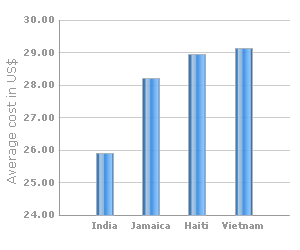
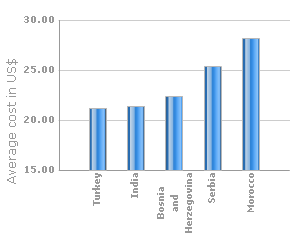
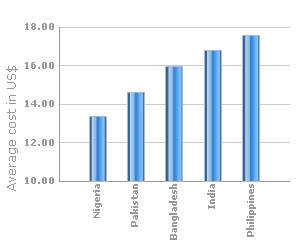
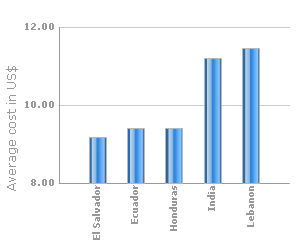
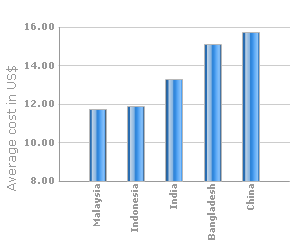
World Bank maintains an intersting stastic of cost of sending money from one country to another for small remittances – $250 and $635 USD equivalent.

The most interesting inference that can be drawn from these graphs is the constitution of the immigrant work force in the country of origin for the remittance. The cost of transfering money also represents the development of the receiving countries banking system.

Interestingly India appears to be one of the top 5 destinations to which money can be remitted cheaply in most of the cases, which shows the spread of Indian workforce across the globe.

A few samples from the World Bank site are reproduced below:

Canada can_1033

Francefra_1033

Germanydeu_1033

United Kingdomgbr_1033


United Statesusa_1033

Singaporesgp_1033


Save, Invest & Grow Your Wealth