Tag Archives: INR/SGD

SGD INR: Implied Exchange Rates

Its been a while since I posted and SGD INR has gone on a see-saw ride since then :). People holding SGD against INR were taken aback the quick fall from 45 to 42 in a matter of days.

As always I stick to the strategy to convert and invest in Indian NRE accounts if you are happy with a 9% yield and have a time frame of atleast 1 year.

Here is the chart that gives the implied SGD INR rate based on Interest rates…Rule of the thumb is to convert whenever the Exchange rate stays above the Red line.

The current implied rate is 42.30Rs/$, which also is a strong support for the pair.

Having said that if Indian Govt follows reforms aggresively INR is bound to appreciate and the pair would breach the line downwards.


SGD-INR: Expected to maintain 38~40 range post Budget

The Indian rupee has moved within the expected range of 38.0 ~ 39.5 for the past few weeks as the Greek bailout unfolded and the Indian government presented the 2012 budget. As we near towards the end of first quarter its time to take stock of the old and new variables at play.

The Euro situation

It would be naive to say that the eurozone crisis is completely resolved. This is a temporary respite as policy makers try and reign in situations in Spain, Portugal and Italy which could spell bigger trouble. The general analyst consensus is for a weakening Euro. Any weakness in euro would be Rupee negative as it would impact exports

Interest rates in India

RBI paused the regime of interest rate hikes in its latest monetary policy statement. The tug here is between inflation and growth, the expectation is for RBI to start lowering rates in the second half of the year. Oil Prices as always would be a key here as a large part of foreign exchange outflows are used towards the oil bill. I am expecting rupee to move in the 48.5~51.5 range against USD for next few weeks.

One factor which could result in rupee weakness as a result of FII outflows is the new tax law that allows the Income tax department to charge corporations for past dealings.

Singapore Growth

The Singapore exports grew at a impressive 30% and another survey results highlighted Singapore economy to be most resilient of all Asian economies. This would attract investment flows into Singapore but the expectation is for SGD to stay around the 1.26 level against the USD.

Putting all these aspects together I am expecting INR to stay within the 38 ~ 40 range (widening it by 50p due to positives for SGD and INR negatives). The overall bias should still remain INR positive.

So my strategy would be convert at any rate above Rs.39.75 if you are looking to invest in India

SGD INR – What’s in store for 2012

2011, what a year it has been for the global markets and SGD INR has been a party to it. The pair started the year at 35.10 and finished at 40.74 a rise of 16%. However the pair has resumed the downtrend and is trading at 39.30 as I write – a drop of 4% from the year-end close.

Let me highlight how the past analysis has fared before delving into how the pair could move in 2012.

In the first post of the series on 23 April 2011 SGD INR – Has anything really changed the recommendation was to convert to INR and invest in deposits. The exchange rate was 35.50 on the date of writing and my recommendation was it could touch 36.5. this target was achieved on 30 May 2011.

The pair continued to move along the interest rate parity line and Tax Adjusted rate line for next 6 months before Rupee began its downslide in Sep 2011 due to weakening economy, uncontrolled inflation and financial turmoil in the global markets.

As Rupee slid from 48 to 54 against the US Dollar (USD) in the next three months its slide against the Singapore dollar was 37 to 41 – drop of 10% against either currencies.

When SGD breached 39 the prediction was for it to ride the momentum and cross 40 SGD Breaches 39 mark, Eyeing 40.

The prediction came true and Rupee went all the way to 41. In the post on 27th Nov 2011 the prediction was made for a pull back with pair ranging between 38.75 – 39.06 40 breached, What’s Next  which is on track as the pair is moving towards the 39 mark.

In the mean time a very interesting development happened as Reserve Bank of India (RBI) deregulated the NRE deposit rates to boost foreign currency supply in the market Now NRE Deposit yield 9.25%, and yes its Tax Free.

Having looked at all these factors here is my take for 2012 (stay tuned for updates every quarter, its very difficult to take a long term view in such volatile markets)

  • INR should strengthen against all currencies and SGD would be no exception.
  • On an Interest rate parity analysis SGD converted to INR and invested in an NRE account would grow to 43.25 in a years time at todays conversion rate of 39.5. The Rule I follow is to convert whenever the actual rate is above the implied rate line
  • With NRE deposits becoming tax free repatriating money in and out of India is easier
  • With Rupee strengthening the gains should be compounded for any investments made in INR

So unless you feel that SGD is headed towards a Rs45 mark in the next year investing in INR is sure to yield good return.


The Fall and Rise of Indian Rupee: 45 days to lows, 45 to recovery

What a roller coaster ride the past 3 months have been!

The rupee was trading at 48.6 against in the US dollar on 31st Oct 2011 and precipitated to touch 53.70 on 15 Dec 2011, a 10% drop. These were the historic lows for the currency and with RBI’s policy changes the rate as I write is 50 against the dollar with RBI reducing the CRR rate and rupee gaining 7% from the lows.

Inflation, falling growth numbers, uncertainity in Europe (which by the way still exists) and political roadblocks to financial reform were stated as the reasons for the weakness. All the reasons held resposible for rupees weakness are still there. Yes, inflation has eased a bit but thats pretty much the only change.

Among numerous suggestions aired to aid the rupee was for RBI to conduct open market purchases in style of Indonesian Central bank which burnt 8-9% of its foreign reserves to stabilise the rupiah. RBI however refrained and relaxed rules to make term deposits attractive for Non Residents Indians – and NRI’s did bring in money into India.

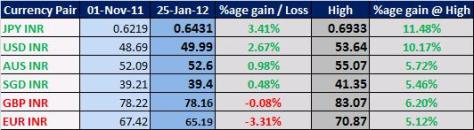
Lets see how has rupee faired against the other currencies in the past 90 days

Surprised – right!! You did not expect to see these numbers, neither did I.

Interestingly after 3 months the INR has returned back to almost where it started against all major currencies and even managed a small gain against GBP and EUR

Against the USD the losses are paltry 2.6% which is close to long term volatility number. JPY on the other hand does come up as unexpected top winner against the Rupee with gains of 3.4%, but the real numbers are the ones shown in the last column.

Extreme volatility is what the data screams – with rupee having lost over 10% against USD and JPY and over 5% against the other pairs.

Question now would be are we expecting another such bout of swings in the market?

I would say unlikely unless a sovereign default event happens.

and how about the direction of Rupee?

I am putting my money on a stable to moderately strong outlook. The RBI has held the repo rates, the CRR ratio has come down and with a weakened currency there should be a a bigger impetus on exports which should all be Rupee positive. However the political instability and global financial turmoil could more than negate any positive factors so 49 – 51 against the USD is what I would  be looking at till end of 1st quarter.

Now NRE Deposit yield 9.25%, and yes its Tax Free!!

NRE or NRO – that was a constant questions NRI’s always had when investing in deposits in India.

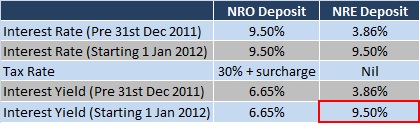
NRO accounts got paid almost same interest rates as the term deposit rates for resident Indians whereas NRE rates were much lesser – almost a half of NRO interest rates (Banks could not offer more than 275 basis points above the global benchmark London Inter-Bank Offered Rate (LIBOR) on NRE term deposits). So if NRO account was fetching 9% then NRE account would get 4%. The catch of course was 2 critical components:

  • Interest on NRE deposits is tax-free whereas NRO attracts 30% tax
  • Both Principal and Interest in NRE account can be repatriated without any restriction but for an NRO account only interest could be repatriated

With the RBI move to deregulate the interest rates on NRE and NRO accounts on 17th Dec 2011 the stage was set for reform. After 10 days Banks came out and increased the rates on NRE deposits.

The comparison between a NRE and NRO deposit now is extremely compelling in the favor of NRE account.

So here is my recommended strategy

  1. Use a bank that has a favorable online remittance service to India. The 3 which I prefer are money2india.com by ICICI bank, Axis Remit by Axis Bank, QuickRemit by HDFC (you could use Kotak bank as well but I have not used their service). All the above banks usually take a 0.5%~1.0% cut from the inter bank exchange rate.
  2. Check the cost of conversion when converting back to Forex (Citibank and other foreign banks have usually charge up to 2% so avoid them)
  3. Open the NRE Bank account, if you don’t have one, preferably with the bank whose service you want to use to transfer money – get in touch with a relationship manager and negotiate a good exchange rate incase the bank has overseas branch

The only 2 downsides that I can foresee are:

  • Rupee continues the downward slide and the interest rate gains are wiped out by currency depreciation (the probability is low)
  • Finance Ministry introduces tax on the NRE account and bring it on par with the NRO account in the upcoming budget – if this happens then the yields would go down but the benefit of being able to repatriate money out of India would still remain

Forty Breached, What’s Next??

SGD finally breached the 40 mark against the INR and as anticipated in mid Oct all that was needed was some more chaos in the global financial markets and a move of INR to 52 against the USD and SGD claiming the 1.30 mark. Lots of movement – right?

So the obvious question which would come to mind is where is the pair headed next? Can it stay above the 40 mark? Can it march towards the 45 territory? or is it slated to drop back to 36-38 territory?

INR quickly precipitating to 52.7 mark and RBI not intervening was a surprise, people eagerly waited for an indication from the RBI governor and it finally came in the last week.

In Singapore on the other side  the inflation quickened pace predominantly attributed to weaker SGD but it did help exports.

Now the stage is set for some pullback – RBI governor relaxed rules on how much money the Indian companies could borrow in foreign markets and also increased the interest rates on the NRI accounts. Both the measures should help strengthen the Rupee as more Foreign money flows into India. The Interest Rates are still attractive @ 10% and make the deposits in India a good investment.

MAS on the other hand might let the SGD stay against the current levels to keep growth intact.

I am expecting the INR to slowly ease back to the 50 mark against the USD and SGD to hover in the 1.28 ~ 1.30 range with occasional bouts of spikes to 1.32/1.33 mark.

This should make the SGD INR pair volatile with base rate around 38.75 ~ 39.06 with occasional drops to 37.5.

Yes I am expecting a pull back!

There is an odd chance of INR moving to 55 against the USD if Italy defaults or some odd event happens in Europe. The key here would be the price of Oil for RBI, if the price falls substantially – RBI would not intervene in the market even if the rupee went all the way to 55, but if the current rates of 90$+ continues then RBI would be left with no choice but to sell some dollars and reign in the fuel price fuelled inflation

If Singapore heads to a Technical Recession what happens to SGD INR??

Market has been rife about Singapore heading into a technical recession in 3rd Quarter of 2011. Prime Minister has revised the overall growth outlook downwards in the National Day speech and there has been a steady decline in the Electronics Export and other trading activities.

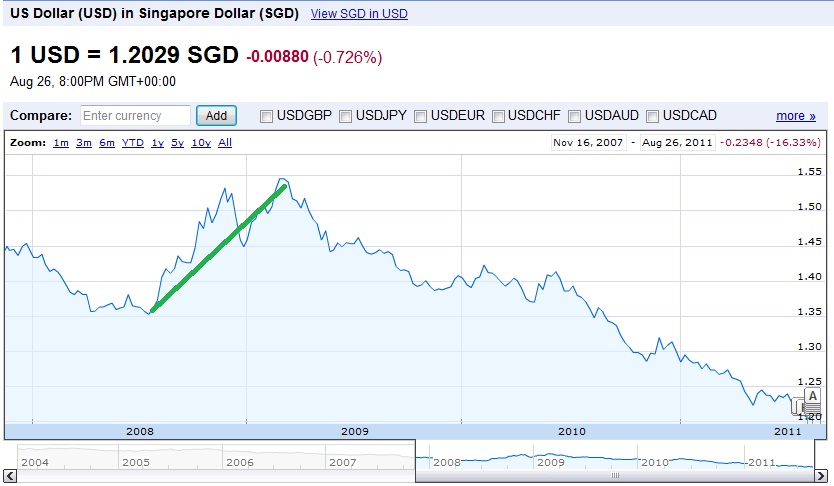
A technical recession occurs when a economy experiences negative growth for 2 consecutive quarters. To spur the economic growth I would expect the fiscal authority to ease out the rise in Singapore dollar to make exports more competetive. Lets look at what happened in  the last technical recession of 2008.

The Singapore dollar depreciated 14% against the USD and moved from 1.35 to 1.54 in a span of 6 months!!

Now what does this mean for SGD-INR that is had a spectacular run of 9% annualised appreaciation in past 4 years?

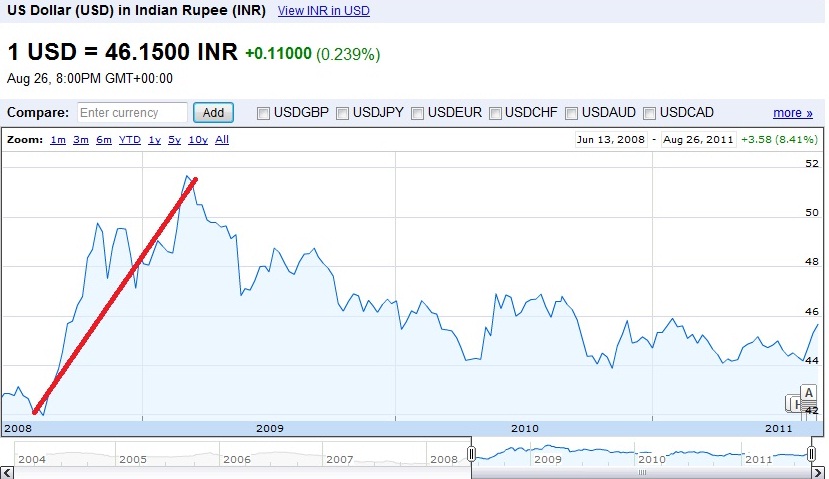
Simply speaking the SGD INR is a cross pair between SGD-USD and USD-INR therefore a weakening of SGD against USD would result in a decline in SGD – INR. The current USD-INR rate is 46.25 and SGD-USD is at 1.203. To get a better view lets see what happened to USD INR in the same period where SGD fell against the USD

USD – INR moved to 51.5  from 42 in the same time frame which is a gain of 20%.

Scenario 1

Using the two gain numbers of 14% and 20% the USD-SGD pair should move to 1.37 from 1.20 as of today and USD-INR would touch 55.5. The cross rate usinf these calculations would come out to 40.51 for SGD – INR.

I am sure all who have SGD holdings would get all excited seeing the figure, but before getting too excited lets look at other possibilities.

Scenario 2

The INR going beyond 50 mark will spell trouble for the Indian economy specially if the Oil prices remain around the $80 mark and the Reserve bank of India would intervene to stem  the rise. So a possible future rate where the SGD weakens 14% the cross rate would come out to 36.50.

Scenario 3

Another possibility is that the SGD depreciates around 7-8% and moves to the 1.30 mark then SGD INR would be at the 38.46, assuming that INR moves to 50 against the USD which is also the current rate.

Now lets throw in the Interest Rate of 10% for Term Deposits in India – for a 6 month period from the current rate of 38.4 any money invested in India would yield 40.32 in target rate (tax free) which is close to the rates in scenario 1. On a post tax basis the amount would grow to yield 39.74.

So we have the facts lined up and no matter what the scenario is, repatriating money to India makes a lot of sense.

SGD/INR – Has anything really changed??


Its been almost a year since I wrote anything on SGD INR or for that matter anything else. With the rate hovering around 35 there have been quite a few requests for me to express my views and here is my opinion.

How has the Past Analysis fared?

In my last post  (10th May 2010) I had recommended that converting SGD to INR at 33+ mark as it is beneficial based on Interest Rate Parity:

  1. Interest Rate on secured deposits  in India was 8% or more making conversion attractive and
  2.  The expectation was a downward movement from then rate of 32.4 against one SGD to Rs.30 giving additional gains

The first part of analysis held good but the rate moved opposite  – towards the Rs. 35 mark.

The instant question that comes to mind is Did I lose if I converted to INR instead of holding SGD’s?

The answer is NO. As per recommendation the pair moved to 33.29 within 2 weeks of recommendation on 21 May 2010. One Dollar coverted to INR @ 33.29 for 1 year and invested @ 8% would grow to 35.95 which is less than todays interbank rate of 35.85

Whats the recommendation for upcoming months?

I am going to stick with my recommendation that converting SGD to INR is beneficial in all situations and one would not loose by repartriating money to India and parking in fixed deposits.

The Interest Rates have strenghthened to 9.5% as of today and conversion has become even more attractive. To substantiate – lets say we convert 1 SGD @ 35.85  now and invest @ 9.5%, it will grow to 39.25 in one years time. Would SGD INR touch 39.25 in one year? Unlikely!!

SGD INR rate is a cross between USD-INR and USD-SGD for which the current rate is 44.25 and 1.235 respectively. For SGD INR to fetch 39.25 in a year the USD-SGD would have to move to 1.13, assuming that there is no change to USD INR.

Consensus on the street is that USD-SGD could move up to 1.19 by October 2011. Even if INR weakens to 46 against the USD the possible rate would be  38.65 after a year which is lesser than what you get by investing in a Fixed Deposit.

How do I decide when is a good time to convert?

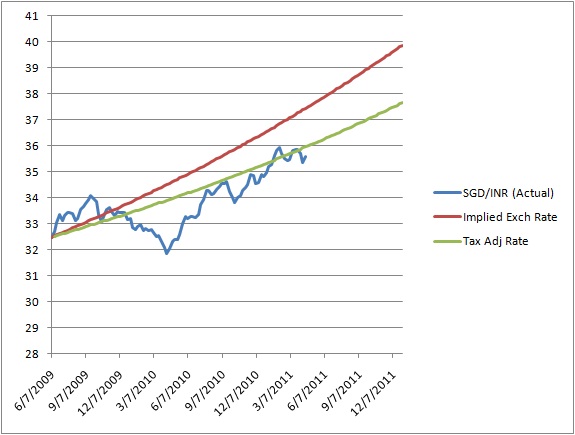
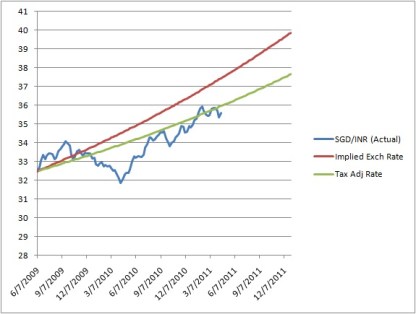
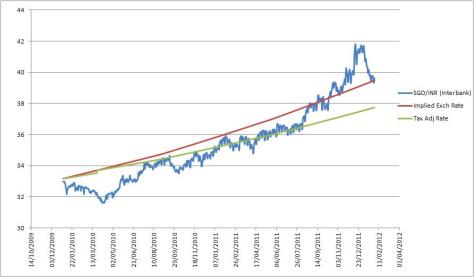
Exchange rates do not move linearly and with the volatility its difficult to know if its a good time to convert. Also at the request of few readers I have added the dimension of taxability of interest income @ 30%. The below graph shows the movement of SGD INR for the past 2 years.
Two important observations are:

  1. SGD INR has stayed below the Tax Adjusted Implied Rate (TAIR) line except 2 occasions
  2. Its beneficial to convert to INR whenever the actual rate moves away positively from the TAIR.

On 13 Sep 2009 the TAIR was 32.94 and Actual Rate was 33.94, Actual Rate moved back to TAIR of 33.01 on 4 Oct 2009. On 30 Jan 2011 the Actual Rate was 35.81 against the TAIR of 35.49 and the two converged to 35.53 by 6 Feb 2011.

The chart below shows the prediction based on curent exchange rate of 35.85, Interest rate of 8.5% till 30 June 2011 and 9% after that till 31 Dec 2011, tax of 30% and Start of Year Rate of 34.96:
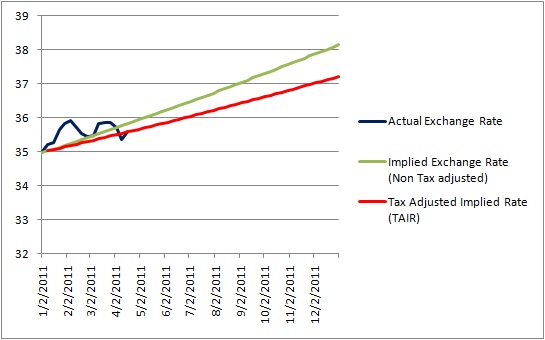
 

The expectation is that with the Singapore elections on 7 May 2011 the SGD might appreciate quickly towards 1.19 against the USD giving a possible rate of 36.5 in next 2 weeks. If this happens you know what to do!!

———————————————————————————————————————————————


Update – 30 May 2011

The Interbank Rate moved up to 36.55 today – target achieved. There is a slight possibility of the pair flirting with 37 levels but 36.5 is a good rate to convert.

 

SGD INR – whats in store for 2010

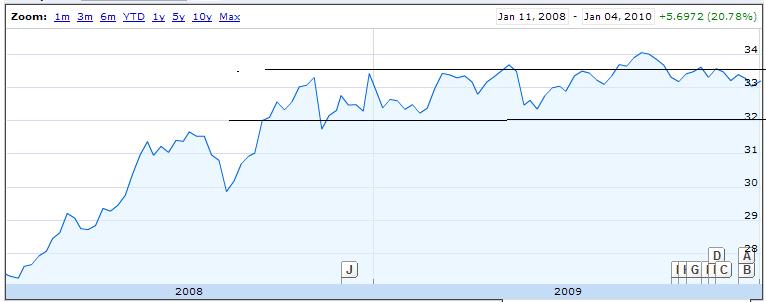
2009 proved to be a volatile year for a lot of currencies – specially the pairs with USD as one of the component, but the cross currency rates like SGD/INR showed relative stability. The pair has moved between 32 and 33.5 over the past 2 years.

The question a lot of you would be asking is what happens in 2010? So here is my analysis.

I expect SGD/INR to turn towards 32 to 30 range over the next 6 months to a year. A look at the chart below would show that the pair failed to stay past 34 mark even though it crossed it once. The pair has been hovering betwen the 33 – 33.5 mark for past 6 months. 


SGD-USD movement

The Singapore Monetary authority has been maintaining a policy of gradual appreciation of SGD against the USD. This has been giving SGD strength against the INR as well (SGD/INR) being a cross rate.  The latest economic data shows that the Singapore GDP shrank by 6.8% in Q42009. This would force the MAS to rethink about the strong SGD approach. The most likely scenario is for SGD to move to the 1.45 – 1.50 range against the USD. traditionaly the MAS has allowed SGD to strenthen against basket of currencies with growth in SGD.

INR-USD movement

Indian economy on the other hand has been performing well and the projected growth in GDP is 6.5 to 7.5%. With improving GDP numbers and growth in economy the INR should strenthen back to its long term mean of 44 – 45 against the dollar. Using these two assumptions we can plot the projected move of INR against SGD.

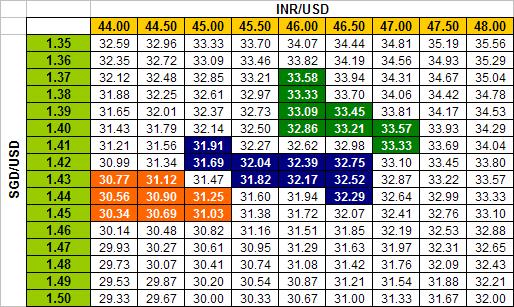
Cross Rates between SGD/INR based on possible values of SGD/USD and INR/USD

The cells in dark green indicate the current range of SGD-INR depending on the rates of SGD and INR against the USD.

The cells in dark blue indicate the possible rates as the currencies re-adjust giving a range of 31.9 to 32.75 (this is the short term expectation – for next 3 to 6 months)

The cell is amber indicate the longish term range as the growth gathers steam over next 1 year.

So as always – I would recommend converting converting SGD to INR at any rate above Rs.33 for a Singapore dollar.