Category Archives: Remittances

SGD INR stuck in a range?

Its been a few months since I wrote about the pair as most of the discussions were in comments to previous posts, but today’s MAS decision warranted a new post.

There were ripe speculations that MAS is going to ease the monetary policy (which it did) and Singapore is headed for a technical recession. The economy expanded by a modest 0.1% much against the consensus of a contraction of 0.1%. The immediate impact on the exchange rate was a modest gain from 1.4025 overnight to 1.3960 as I write.

One would question that why has SGD strengthened even though the policy has been slightly eased? There are various factors at play:

  1. The expectations of a USD rate increase this year are negligible. I would be surprised if the Fed raised the rates in Dec when the volumes are thin due to holiday season. My personal view is that it was a missed opportunity in Sep and Fed should have increased the rates but that’s a different topic of discussion.
  2. SGD had fallen all the way to 1.43 in anticipation of easing, but recovered slowly over the past week with rest of the regional currencies. If one looks at the bigger picture then Indonesian Rupiah has appreciated by around 9% against the USD and Malaysian Ringgit has firmed up by around 6% in past 10 days. The key words for me from the MAS policy statement is “slow the pace of local dollar’s gain”

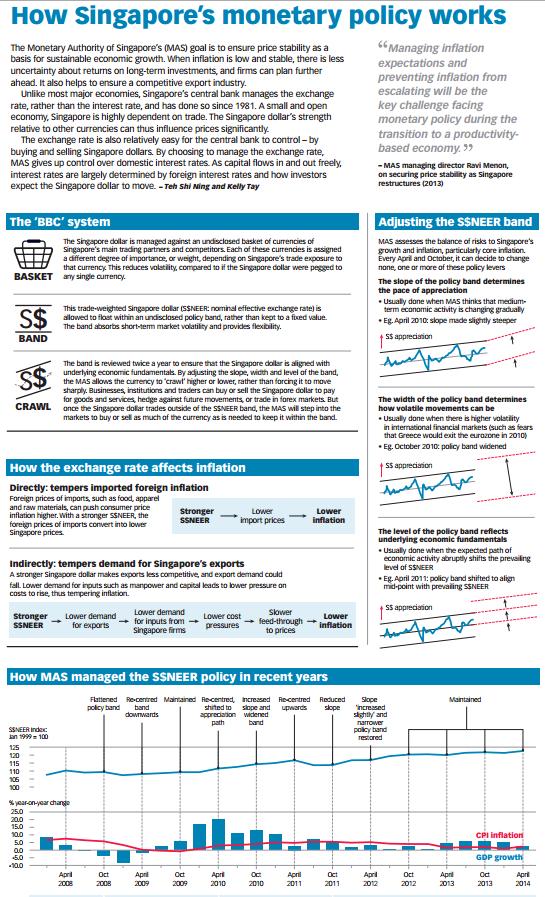
MAS will continue with the policy of a modest and gradual appreciation of the Singapore Dollar Nominal Effective Exchange Rate (S$NEER) policy band. However, the rate of appreciation will be reduced slightly. There will be no change to the width of the policy band and the level at which it is centered, saying it would seek to slow the pace of the local dollar’s gains versus its trading partners.

Both Malaysia and Indonesia are key trading partners for Singapore and a greater than 5% jump in their currencies diluted any chance of SGD depreciation. The intent of MAS Is clear – it wants SGD to be slightly stronger than its trading partners.

Now if one looks at INR it appreciated very quickly in after the US job reports from the comfort that no fed hike is on the cards. It was good news for FII’s who can pump money in Indian Bonds and earn good interest rate. Many mistake this as FII investment in India because if one looks at the economic indicators they don’t look very good – be it industrial production. agriculture produce or job growth.

I have said this many times and would repeat again – the sooner INR falls towards 70 the better it is for India. The Indian exports are declining due to competition from other countries with weaker currencies and the day fed hikes the interest rate INR could dip 2-3% overnight and that is not a pleasant shock for the economy.

Anyway for now no major events are scheduled in the coming months other that the results of the BIHAR elections. I believe irrespective of the outcome the Rupee is scheduled to fall post-election results. If BJP wins there would be a knee jerk appreciation which will fizzle out as the economic data and realities will take center stage. If BJP looses then Rupee would immediately fall from a sentiment perspective.

So for the next few weeks I expect SGD INR to be range bound between 46-48.
Best options to Transfer Money from Singapore to India

With the jump in SGD INR the question of what is the best way to transfer money to India becomes important and has been asked a few times. My conclusion before today’s analysis was that DBS remit gives the best rates with the smoothest transaction experience. However in such a competitive market innovations and better pricing is expected and ICICI Bank with its new offering beats competition by a mile.

At the time of comparison the Spot SGD INR was 47.75 and below table shows how the 3 services which offer confirmed Rate transfer compared:

Service 3000 5000 10000 15000 20000
Money2India 47.18 47.35 47.48 47.52 47.54
DBS Remit 47.22 47.22 47.22 47.22 47.22
SBI Remit 47.3 47.3 47.3

As you can see for amounts 5000 SGD or more money2india had a substantially better rate than the competition and that happens because they have started charging 25SGD flat fee and reduced currency spreads. The rate money2india used was 47.66 and the results above are shows after taking the 25sgd fee and service charges into account.

Ofcourse the rates offered by money2india would change throughout the day but for transferring amounts greater than 5000 this would be my service of choice (the only other way to get a better rate is if you can find someone who wants SGD and would give you INR and deal at spot)

Couple of things to Note for Money2India transfer Service

1. Only allows upto 400,000 Rs equivalent to be transferred per day using the fixed rate service.

2. The rate is updated around 12:00 noon Singapore time

3.  Has a internal daily limit i.e. if the amount they have allocated for a day has been reached customers are refused transfers

I would have expected that there be no limit on amounts being transferred. With these limits it feels that money2india wants to only have small transactions so that they can earn more transfer fee. The rate still is better than DBS but as a customer I find these limits back door way of giving less to customers.

Update: Money2India no longer has fixed fee transfer service and the rates offered are not as good as SBI or DBS. For comparison of rates please refer to the widget on right or at the bottom (when using a phone)

MAS Holds Off Easing and SGD jumps…

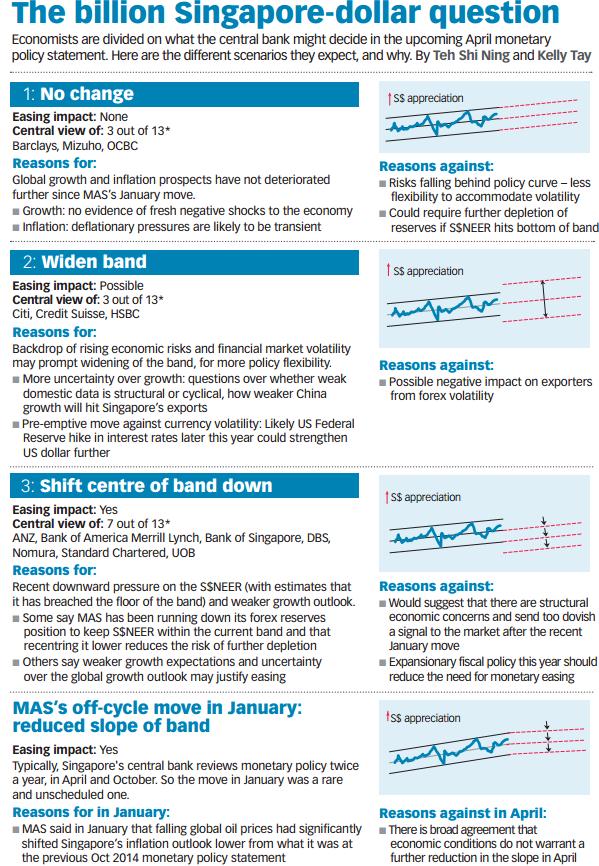
As expected, MAS held off any more easing as the GDP numbers were better than expected, SGD quickly jumped back to below 1.36 and I expect it to go below 1.35 in days to come.

There are 2 very interesting and informative info graphics that were published in Business Times on 12th and 13th April that I am sharing with every one who are interested to know how does NEER work and monetary policy is administered.

Billion SGD question How Policy Works

RBI Cuts Benchmark Rates – Now What?

The much talked about interest rate cut finally happened today. RBI Governor keeping true to his character surprised the markets with an earlier than expected cut taking India on a path different from Russia and Brazil where central banks have increased the benchmark rates in the past few weeks.

I must say it’s a brilliant move by the Governor to put the ball back into Finance Ministers court and push for structural fiscal reforms in the upcoming budget. The general sentiment has been that the higher rates are keeping India from growing which overshadows the fundamental issues of red tape, poor infrastructure and wastage in public expenditure.

The sustained fall in oil prices (thank Russia for occupying Crimea) has given India the much-needed window to push through reforms without being worried about stroking uncontrolled inflation.

The question is that will this rate cut and structural reforms be enough to achieve the targeted growth? No, absolutely not. The other key factor, which should not be ignored, is the exchange rate of the rupee against other currencies. To recap the last year – Rupee has oscillated between 58 and 63.5 against the US dollar (I use USD as a benchmark because the other rates are nothing but a cross rate). The fall in rupee has been less pronounced as compared to its Asian peers like the Malaysian Ringgit, Indonesian Rupiah, Singapore Dollar, Korean Won etc. On the global front, the Yen, Euro and Pound have also dropped sharply against the USD resulting in net gains by the Rupee against these currencies as well.

While the gains in Rupee boost the feel good factor about the India story – is a sustained gain in Rupee the right thing for the Indian economy? My take is that RBI would not let Rupee gain beyond the 62 mark to keep the exports competitive. There was evidence of this when RBI was seen buying dollars in the last week when Rupee gained sharply. With a generally weaker Rupiah, Ringgit, Peso and Riel the Indian exports would face tough competition in areas like garments, IT services, food grains and other manufacturing. Also with Euro and Pound weakening the demand from European countries would decline if the goods are not priced competitively.

With crude oil staying below 50, I think RBI would target the Rupee around 65 against the USD (at-least that’s would I would do, if I were the RBI governor). That would be a roughly 5% decline from the current levels and will bring it at par with other countries with export competitiveness. A sharp gain in the currency would negate any benefit that the lower oil prices would have and I don’t think the RBI or the finance minister would want that.

We should not forget that infrastructure reforms do not happen overnight and take years to fully have the desired impact.

What would that do to SGD INR – 45 mark would remain as the strong support for the pair with upside of Rs.50, but of-course remitting money to India and investing in NRE deposits would always remain a good option.

SGD INR: 50 with SG@50?

Ever since the Prime Minister Modi came to power the feel good factor about Indian economy and India has increased dramatically. All Indians, including me, are rooting for improved Indian economy – infrastructure reforms, streamlining of tax code, improved law and order and not to forget getting back the black money stashed in overseas accounts. The expectation also is for the Rupee to strengthen as reforms kick in and help kick-start the much-anticipated economic growth.

The past few months have seen the pair oscillating between the 46-49 range and the volatility in the forex markets has been nothing short of a roller coaster ride. The pair dropped all the way to 46.5 after  the elections and bumped back up towards 49 only to test 46.5 again as the oil prices slid in the international markets (I was expecting a 45 floor as mentioned in replies to questions in the previous post).

SGD INR Dec 2014

INR has weakened against the USD to 63 as I had written earlier in (SGD INR: Post Election Euphoria) but interestingly SGD has also weakened in tandem. At one point in time the fall in SGD was greater as compared to INR and caused SGD INR to test 46.5.

Oil has fallen dramatically in the past few weeks and raised concerns of Central Banks not being able to meet their inflation targets prompting talk about monetary easing. A falling oil is good for India’s Forex reserves which has lent some support to the Rupee. On the other hand though the market sentiment remained weak as India’s trade deficit widened to one-and-a-half year high of $16.86 billion in November due to over six-fold jump in gold imports. Trade deficit in November last year was $9.57
billion.

The key events in play as I write are:

  1. Falling oil Prices and the rout of Rouble
  2. Bank of Japan’s push to achieve 2% inflation
  3. Expectation of FED rate hike in 2015

Falling oil prices can make the FED hold on to rate hike and also bring strength to SGD as the safe haven theory comes back into play. My expectation is for the Singapore Dollar to appreciate back to sub 1.30 level and Indian rupee to move upto 65 level which would bring the SGD INR back at the magical 50 mark in time for Singapore’s 50th birthday


SGD INR: A storm in making

It’s a new year and right about time to do a pulse check on INR for the coming year. The past few months I was very busy at work and with the currency being relatively stable I did not want to write something just for the sake of writing. As mentioned in the October post the currency stabilised in the last quarter of 2013 and stayed well within the 60-65 range against the US dollar and hovered around the 49 mark against the SGD (INR – Directionless in 4th Quarter)

One would have expected things to remain calm for a few more weeks in 2014 before the Indian Budget and upcoming elections in March and May respectively but the global markets had something else in mind.

The Federal Reserve started the much-anticipated tapering of Quantitative Easing (QE) in December, with reducing the Bond purchases by 10 Billion USD a month to 75 Billion and followed it by a reduction of another 10 Billion in January 2014 which spooked the emerging markets.

Turkish Lira and Hungarian Forint were aggressively sold off and the Argentinian Peso is unofficially devalued. The data from China is not exactly exciting and Indonesian Rupiah and Thai Baht have their own set of problems to deal with. At the same time the RBI came out and surprisingly increased the benchmark rates in January announcements which I thing was more of a pre-emptive move to shore up defences against any potential sell off in the Rupee. With such weakness in the other Emerging market currencies the Indian Rupee, I must say, held ground very well.

But this is just the start of the year and there are quite a few events lined up in the coming months that would determine which way the Rupee moves. On the global macro side the course of Global Financial Markets a.k.a. the pace of QE would drive the general sentiments towards emerging markets. On the domestic front The Indian Budget announcements and the general elections would be the key determinants.

Looking at the global front I do not expect the federal reserve to stop tapering and ultimately end the QE program unless there is definitive bad news on the US unemployment and inflation. This reduction in QE would be Rupee negative and as in May – Aug 2013 time frame has the potential to push the Rupee down.

On the domestic front anything short of a stable government with full majority would be a negative for the markets. I think that this stage there is no one clear party that I could say would achieve the majority.

So in the short-medium term of next 3-4 months the chips are stacked against the rupee and I do expect it to touch trade towards the 65-67 mark.

What that does to SGD INR? Well the SGD has slightly weakened against the USD and has been trading at 1.27-1.28 area. Deteriorating global fundamentals tend to result in strengthening SGD as a safe haven currency. So with the expected weakness in the Rupee and potential appreciation of the SGD, SGD INR could march back to the 53 mark in the coming months.

SGD INR: Unexpected Rupee Weakness

The sudden weakness in the Rupee has caught most of us by surprise and has caused Rupee to cross the 45 mark once again agsinst the Singapore Dollar.

I was expecting the pair to face stiff resistance at 44 mark and not breach the 44 mark any time soon (Sgd Inr expected trend till end of June 2013). The rationale being that SGD and INR would both move in tandem against the USD which would make SGD INR a stable pair.

However SGD strengthened very quickly from the 1.27 mark against USD to 1.25 in a matter of few days on its safe haven appeal with the fear over slowing global growth and Fed reconsidering the pace of Quantitative Easing (QE). My expectation was for SGD to touch 1.28 before starting to strengthen again

Indian Rupee (INR) on the other hand weakened against the USD with rising Gold Imports and expanding deficit and is nearing 57 against the USD as I write.

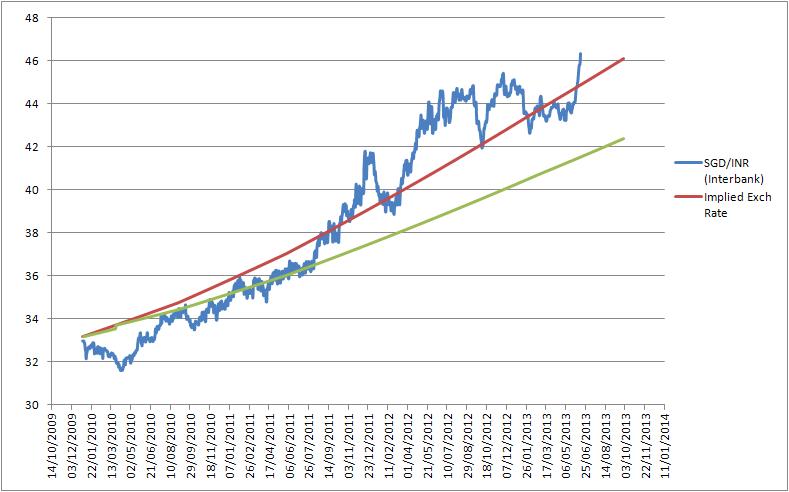
Its worrthwhile to look at the long term Implied Interest Rates trend line for SGD INR with such sudden changes

SGD INR Jun 2013

Its quite evident from the trend line that everytime SGD INR has crossed the trend line it tends to reverse back to the mean. Every cross over is a good opportunity to convert to INR for investment or other purposes.

Market rumours suggest INR would touch the 58 mark against the US dollar which could see SGD INR crossing the 46 mark which for me would be a great level to convert.

My suggestion as always is convert in small amounts to average out your conversion rate as its not possible to catch the top and bottom of any market.

SGD INR – Expected Trend till Mar 2013

Its hard to believe that we are already in February of 2013 and that calls for me to keep up on my promise and share with you my thoughts on SGD INR movements in the near term.

The trend so far has been inline with what I had expected in Dec 2012 – The pair has maintained the range of 42-46 with a downward bias (Read more: SGD-INR: How does 2013 look like?) and trades at 42.99 as I write.

SGD INR made multiple attempts to breach the 45 mark but have been unsuccessful. In the meantime a few interesting developments have happened on the fundamental front.

RBI came out and cut the rates by 25 basis points to stroke growth and the financial markets have taken a more “risk on” approach. The former would result in NRE deposit rates being lowered in the long term and the latter would attract FII in to the Indian Markets chasing growth.

At the same time the Indian Finance minister has promised financial reforms and started with reducing the fuel subsidies which helps reduce the Indian Budget deficit. This is also positive for the Rupee.

On the SGD front the currency has lost 2% against the USD and now trades at 1.24 as compared to 1.22 late last year.

These factors combined have seen SGD INR soften below 43 mark.

The question which people ask often is that how low will the pair fall and will SGD INR reach 45 again?

My view is that in the short term the pair would increase and move to cross the Rs.44 mark – The US debt ceiling discussions are due soon and so is Indian budget for 2013.

The uncertainty on the policy front would result in INR weakening against the USD which would mean a weaker INR against the SGD.

The recent spike in Crude Oil prices would add to woes for Indian Rupee.

So in-case the recent drop of SGD/INR has left you scrambling like Oct 2012 then don’t panic – next few weeks should give you an opportunity to see the pair touching 44 again.


Enjoy the Holidays and wishing you a very Happy Chinese New Year!! Gong Xi Fa Chai

SGD INR: How does 2013 look like?

4 more days for 2012 to end and its a perfect time to analyse what would 2013 be like for the currency pair.

SGD-INR started the year 2012 at 41.28 and trades at 44.80 at the time of writing, a gain of 8.5%. The pair touched a low of 38.88 and highs of 45.11 during the year a volatility of appx 12%.

Let me take stock of how the past analysis has fared before delving into how the pair could move in 2013.
Continue reading SGD INR: How does 2013 look like?

SGD INR: Implied Exchange Rates

Its been a while since I posted and SGD INR has gone on a see-saw ride since then :). People holding SGD against INR were taken aback the quick fall from 45 to 42 in a matter of days.

As always I stick to the strategy to convert and invest in Indian NRE accounts if you are happy with a 9% yield and have a time frame of atleast 1 year.

Here is the chart that gives the implied SGD INR rate based on Interest rates…Rule of the thumb is to convert whenever the Exchange rate stays above the Red line.

The current implied rate is 42.30Rs/$, which also is a strong support for the pair.

Having said that if Indian Govt follows reforms aggresively INR is bound to appreciate and the pair would breach the line downwards.