INR – Directionless in 4th Quarter

The US debt and budget talks finally reached a resolution yesterday, the congress passed the bill and the much feared US default was averted and the financial markets breathed a sigh of relief. Interestingly the Indian Rupee has been pretty flat both pre and post the US saga.

The drop to 69 against the USD on 28 August was the low point for the Rupee and it steadily regained lost ground in September (Rupee Doing a Bungee Jump – Time to bounce back?) and hovers around 61 as I write.

I often ask myself what has really changed in the past month but can’t find a fundamental reason for the pull back. My take is that it was a technical pull back with Rupee being oversold. Yes one could say that RBI got a new Governor in Raghuram Rajan and that helped Rupees cause, but if changing governors could help the Rupee strengthen by 15% then maybe RBI should abandon monetary policies and use governors to set the direction of the currency :).

Looking at the fundamentals nothing really has changed in the past 2 months – RBI did come up with a FCNR scheme, increase the duty on import of Gold and television sets and a benchmark rate increase. The FCNR scheme is reported to attract 10 billion USD in deposits which would add no more than 3% to the foreign currency reserves. The increase in duty on gold has got the premium over spot soaring in indian markets and made gold smuggling attractive and the increase in duty on television sets has made travel to Thailand and Singapore less attractive – believe it or not bringing in television sets from overseas trips was a great way of subsidizing foreign travel.

On the policy front nothing really has changed in India and no progress is expected until after the next elections in 2014. On the global front there is still a lot of uncertainty and the fear of Quantitative Easing (QE) taper is still there. The general consensus is for no taper before late march 2014 but its an event that will happen sooner or later.

With all the uncertainty and political wrangling I expect the Rupee to remain directionless to the year-end.

63 should act as the pivot against the USD with a variation of 5% either side – a range of 60-65 would be the order. However against the SGD things should be slightly different with 50 acting as a strong magnet.

Rupee Doing a Bungee Jump – Time to bounce back?


The Rupee has breached all predicted floors in the past few days and has fallen like a rock.

It touched an all time low against the US dollar yesterday and traded at 68.78 loosing over 4% in a single day. The fall has been particularly sharp in this week as the rupee lost over 8% in just 3 days. Culprit in this case was the passage of Food Security Bill.

The Rupee was trading at 63.50 in 23 Aug (Friday) and with passing of Food Security Bill on Monday (26th Aug) sharply trended towards the 66 mark.

Food Security Bill (FSB) with all its right intentions of providing for the poor is not something the country can afford. The current account deficit has ballooned to over 4% of GDP and the FSB is estimated to cost 3.5% of GDP.

The looming elections in the coming year has got the ruling government to go after populist measures than trying to take some hard steps and get the economy back on track.

As I write this piece the Reserve Bank of India has come out and declared that it would be selling USD to Oil Corporations directly and this should provide some relief to the falling rupee. I would not be surprised that if the Rupee opens sharply higher and recovers all the losses of yesterday. But this relief rally would be short-lived as the fundamentals behind the fall have not changed. RBI’s step can reduce the volatility and demand in the Forex market but does not change the fact that the country does not have the money its spending.

On the flip side the fall of the Rupee might be a blessing in disguise for the economy. Exports from India become competitive and would bring in much-needed business to India. Where other countries like Japan have been deliberately trying to weaken their currency to improve exports India has this golden opportunity presented to it. Now does the government use it to the countries advantage or squander it away needs to be seen.

As an immediate measure my suggestion would be to launch a scheme to provide amnesty on bringing black money stashed abroad to India and investing them in Rupee denominated Bonds. The size of the black money in India is estimated to be 30% of the GDP as per World bank estimates. Of this 30% at least half is stashed overseas (some figures report higher numbers).

The Finance ministry could launch a scheme with 2 alternatives:

1. Bring in the black money tax-free for investing in non-interest bearing Rupee bonds. The money would be locked in for 3 years.

2. Bring in the black money by paying a 14% tax and investing in 5% interesting bearing Rupee denominated bonds.

With India’s Current Account deficit pegged at 4.9% of GDP and Black money overseas of at least 15% of GDP, this scheme could single-handedly support the falling Indian Rupee and bolster the Indian Government’s coffers. The instant demand for Rupee would push the currency up and bring in long-term capital to the country. Government could go a step ahead and allow the Bond Holders to borrow interest free against the Bonds if Investing Food or Energy Sector.

For the longer term, investments need to be made towards achieving food self-sufficiency and improving energy sector. The money collected through the amnesty scheme could be used to build storage facilities and investing in alternative sources of energy.

Want to eat a Big Mac – Go to India!!

“Ridiculous, Insane, Irrelevant…why the hell does one need to go to India to have a Big Mac, I have a McDonald’s just around the corner!!”

That was the reaction I got when I suggested to one of my friends that having a Big Mac in India might be a good idea. What we were discussing was the recent battering of Indian Rupee and his view was that an Indian national working overseas has gained with the falling rupee.

My stand was that well in pure conversion terms, yes every Dollar, Dinar, Euro or Dirham fetches more rupees but the steady inflation rate of over 8% has made the cost of living in the country higher as well. India is no longer as cheap as it used to be and the cost of living in bigger cities can be more or less similar to any other developed country.

In case you have not guessed by now this friend of mine is not an Indian national.

However to prove his point that indeed things are not as expensive in India he pulled out the Big MC Index on his beloved tablet. Here is what I saw – INR is undervalued by over 50% against the USD.

The interactive index can be viewed at – http://www.economist.com/content/big-mac-index

His defence being that if a McDonald’s Burger costs only USD1.5 in India and is USD 4.56 in US then how can one say things in India are not cheap. This was a classic Purchasing Power Parity evaluation and I could see that no matter what I said there was little I could say to show him the bigger picture. So my instant suggestion was ” Want to eat a Big Mac – Go to India!!”

Well we had a good laugh after our banter but this also made me think that the well reported reasons in the media and business dailies just do not seem to hold well against the traditional – Interest Rate Parity and Purchasing Power Parity theories.

With a interest rate of 7-8% on the government securities and purchasing power parity mismatch, as shown by the mc index, the currency is grossly undervalued. Of course, the Current Account Deficit and the huge spend on Gold and Oil import is a big reason for dollar demands for India.

The deficit issue can be tackled by a two pronged approach – making the country self-reliant for energy needs, and increasing exports. The vast coastal lines, desert areas, and rivers are all perfect venues for investing in alternate sources of energy and exports could be boosted by reaping benefits of the weak rupee. Gold is a bigger beast to tackle as I cannot see how India’s love for gold can ever diminish 🙂

On a side note I would still travel to India to have a McDonald’s burger – not because it’s cheap, just so I can get the McAloo Tikki.

SGD INR: 44… 47… 50?

Now don’t tell me you haven’t wondered if SGD can fetch 50 Rupees per dollar 🙂 and I have to admit that with the current rupee weakness it does not look like a impossible number to achieve.

What’s transpired in past 2 months is nothing short of shocking…personally I never thought that the INR could go past the 60 mark against the US Dollar but then I did not expect the Indian Government to bring in the food security bill, in its current format either, which would cost 3.8% of GDP.

The GDP has already been shrinking and GDP growth is estimated to be well below the 6.5% mark as targeted earlier. With rampant red tape blocking foreign investment, tax evasion and upcoming elections the picture doesn’t look to change dramatically in the near future.

On 8th July the rupee breached the 61 mark against the USD and forced the RBI to step in with measures to stem the fall. Since then rupee has stayed below the 60 mark with a weak undertone.

On the other hand the Singapore economy posted a 3.7% growth for the second quarter of 2013. It was more than 15% growth on a quarter by quarter basis. The results looked good but the guidance does not suggest that the trend would continue.

In the meantime, to moderate the housing market, the Singapore government has come up with total Debt Servicing framework which promotes prudent borrowing practices. The SGD in the same time touched 1.28 and has sea-sawed between 1.25-1.28 mark.

So here is what I think is going to happen – The Singapore dollar would weaken towards the 1.30 mark against the USD. This would do well for the Singapore’s exports and the tourism industry. With the weakening of SGD there are rumours that the borrowing rates would slowly increase to keep the housing markets in check. I personally feel that the debt servicing framework is the first step to ensure residents don’t over leverage while buying a property and get in trouble when the interest rates move up.

So as always million dollar question remains what happens to the SGD INR 🙂

My take is that with INR at 60 and RBI showing resolve to not let is fall below and SGD hovering around the 1.26-1.27 mark the mean price for SGD would remain at 47. If the SGD weakens to 1.30 as expected and Rupee settles at 58 SGD INR should march back below  the 45 mark.

However if the RBI measures fail to have an impact the Rupee could weaken to 63 against the USD, mainly on account of rising oil prices which are the biggest drain on India’s foreign reserve. If that scenarios plays out then their is little to stop the SGD INR to touch the 50 mark.

However if I look at the Big MC Index the Rupee is undervalued by almost 60% using the purchasing power parity – more on that another day

SGD INR: Unexpected Rupee Weakness

The sudden weakness in the Rupee has caught most of us by surprise and has caused Rupee to cross the 45 mark once again agsinst the Singapore Dollar.

I was expecting the pair to face stiff resistance at 44 mark and not breach the 44 mark any time soon (Sgd Inr expected trend till end of June 2013). The rationale being that SGD and INR would both move in tandem against the USD which would make SGD INR a stable pair.

However SGD strengthened very quickly from the 1.27 mark against USD to 1.25 in a matter of few days on its safe haven appeal with the fear over slowing global growth and Fed reconsidering the pace of Quantitative Easing (QE). My expectation was for SGD to touch 1.28 before starting to strengthen again

Indian Rupee (INR) on the other hand weakened against the USD with rising Gold Imports and expanding deficit and is nearing 57 against the USD as I write.

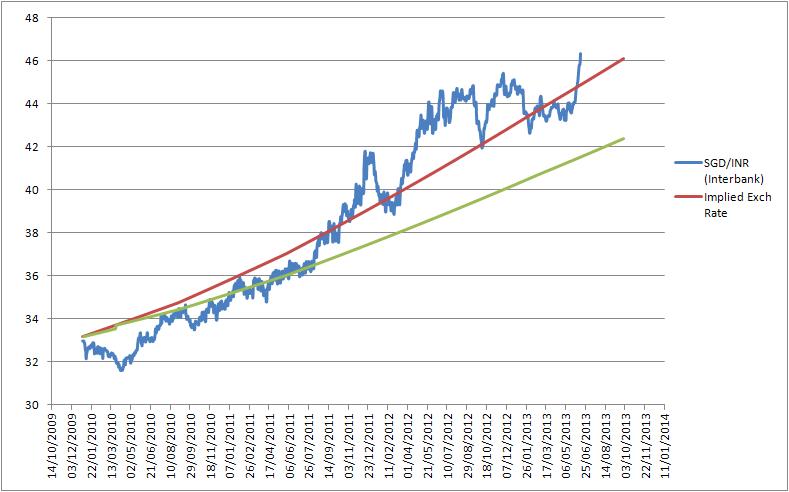
Its worrthwhile to look at the long term Implied Interest Rates trend line for SGD INR with such sudden changes

SGD INR Jun 2013

Its quite evident from the trend line that everytime SGD INR has crossed the trend line it tends to reverse back to the mean. Every cross over is a good opportunity to convert to INR for investment or other purposes.

Market rumours suggest INR would touch the 58 mark against the US dollar which could see SGD INR crossing the 46 mark which for me would be a great level to convert.

My suggestion as always is convert in small amounts to average out your conversion rate as its not possible to catch the top and bottom of any market.

Falling Gold and its YTD Performance in Different Currencies

Gold and Silver have been on a steady decline this year and having lost 17% and 25% respectively in USD terms got me curious to find out if there was any country where the value of these metals increased in the local currency terms.

After some research and marrying the Exchange Rates to the price of Gold and Silver at various points in time I got the below table ready…45 Currencies to look at :).

Gold Silver performance

I did not really find any country where the value had increased but Japan came very close to parity. Gold has lost only 2% value when measured in JPY. Given the massive weakness in JPY over the past few months the gold value has been able to off set the losses when measured in yen terms.

The second closest country was South Afria which has experienced similar currency weakness but not as large as the yen.

On the other extreme are countries like Mexico, China, Thailand and Malaysia where strengthning local currency and growth prospects of economy have aggrevated the losses for those holding gold or silver. Gold is down 22% in Mexican peso terms and 19% when measured in Yuan.

The stark contrast between Japan and Mexico does highlight how Gold and Silver could act as store of wealth when countries go through or are expected to go through inflationary periods or there is a general run on the currency.

Now you would be wondering what is my view on the metals?

Well i treat them as any other investment avenue and continue to have my exposure to these through collectible coins 🙂

SGD INR: Expected Trend till End of June 2013

We are well into second quarter of the year and its time for an update on the SGD INR projection.

Even with my best intentions to share thoughts on the pair as early as April its only now that I got sometime. Neverthless there have been some interesting developments in the past weeks which can impact the movement of the pair and its a good time to try and ascertain the trend in light of these.

On April 13 2013 the MAS maintatined its tight monetary policy stance even though the GDP unexpectedly contracted in the first quarter of the year and On 3 May 2013, the Indian Central bank lowered the key rates to 7.5%.

There was a expectation that with slowing GDP growth the MAS would allow the SGD to weaken against the other currencies and the USD-SGD might touch 1.28 mark. However with the inflationary pressures the monetary authority decided to keep the band and slope of policy bank unchanged.

On the other hand the RBI lowered the rates to boost growth in the slowing Indian economy.

Both the events are positive for the respective currencies and though INR has remained around 54 mark to USD, SGD moved from lows of 1.25 to 1.23 after the news.

With both the currencies showing some strength the SGD INR pair would remain stangnant in the 42-44 band. The pair has formed a strong resistance at the 44 level and I do not see it breaching this in the next few months.

With slowing growth the SGD might march back towards the 1.25 mark which would push the SGD INR pair towards the 42 levels.

So if you are looking to invest in India then a exchange rate of 43.5 – 44 would be a good rate to use

Over 5% annualised return with Low Risk Funds in 3 months

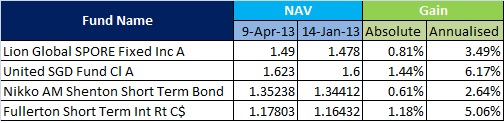
Close to 3 months since I first talked about the Low Risk funds that are liquid and generate good returns in my post – Good returns and Low Risks with Funds that Invest in Singapore Bonds and its great to see that 2 funds have generated over 5% annualised returns in 90 days.

United SGD Fund and Fullerton Short Term Int Rt have gained 1.44% and 1.18% in this period clocking annualised gains of over 6% and 5% annually.

Fund Performance 3 months

My personal favourite Nikko AM has lagged behind at 2.64% annualised but still much better returns than a bank deposit, Though I must say that mid way I did re-allocate some money to United SGD and Fullerton Funds when the SGD crossed the 1.25 mark against the USD.

I have noticed that these funds generate better returns when SGD is strengthening. Looking at the returns in past 3 months I am going to re-balance my portfolio and move some money from US Equities to these funds before the “Sell in May, Go away” phenomenon hits the wall street. Till then enjoy the gains 🙂


SGD @ 1.30 in next 3 months

“What? you must be kidding!!”

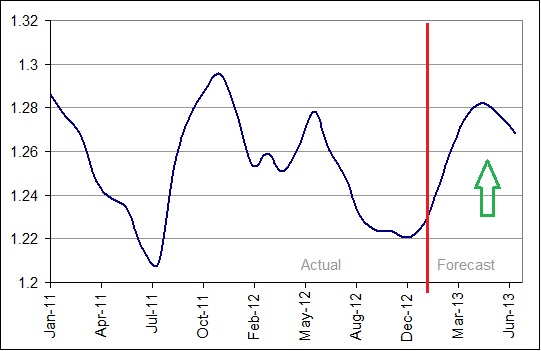
I know, I know – that’s exactly what my reaction was looking at the chart for SGD USD. I would not have bothered to look at the charts if not for SGD breaking 1.24 mark, specially not after the forecasts earlier in the year by leading financial institutions was for SGD USD to break the 1.20 barrier.

SGD forecast

The charts show an interesting trend – the one of SGD bottoming out and heading higher. Overlaying that with macro economic picture confirms the trend.

Now if you are wondering what has changed in just 2 months then I would say its just the feel good factor nothing more, other bits were in the making for long.

MAS provide guidance on SGD through monetary policy and the NEER bands for SGD but rarely suggests a target. The stance of MAS has not changed.

My hypothesis for reasons of SGD weakness primarily starts by looking at the bond markets. Singapore has a robust economy and reserves which make SGD government bonds literally risk free. In the past years money flowed into SGD Bonds seeking safety of capital. Also the property market in Singapore attracted a lot of foreign investors.

With the US stock markets on all time high, Nikkei on a bull run and general sense of economy looking better the capital has started moving from safe havens to more risky assets. I am guessing that the money if moving out of SGD bonds to equities here. Also with the latest government measures to cool down the property market some of the hot money chasing the properties in Singapore would be looking for other avenues. Both these factors mean that demand for SGD denominated assets would go down thereby resulting in lesser demand for Singapore dollars.

With the inflation well within Government targets and  falling fuel prices a weaker SGD augurs well for the economy – specially tourism and services sectors.

You would still be wondering what makes me boldly suggest a 1.3 target specially when the charts suggest a reversal at 1.28 and yes I agree I might have pushed a little too far with 1.30 forecast but markets are not always rational and tend to overshoot, nevertheless 1.28 certainly looks very real 🙂


How much Gold do Central Banks Hold?

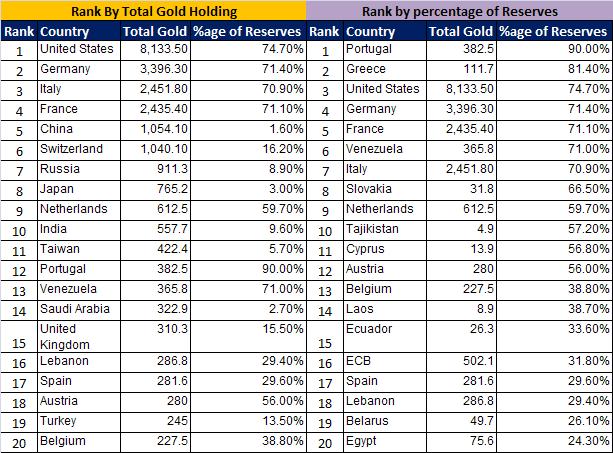
Chanced upon this interesting set of data from World Gold Council on the Gold reserves each country has and the percentage allocation as a part of the Total Reserves.

Gold reserve

It was surprising to see that Portugal has 90% of its reserves held in Gold whereas China has only 1.6% even though the total gold holding is upwards of 1054 tons and ranks 5th on the table. Japan also has a low percentage of 3% and ranks 8th on the table with gold reserves of 765 tons.

One should note that China and Japan own US debt to the tune of 1.2 trillion and 912 billion USD respectively. At current prices the value of Chinese and Japanese Gold is 55 and 40 billion dollars and the US treasury bills make up 35% and 54% of their Reserves.

The high US Gold Holding could be one reason why China and Japan have not increased their exposure to Gold as they would feel they are owning Gold indirectly by owning US securities. In case of a US default the debt could be paid by using Gold reserves.

In the recent months the Chinese purchase of Gold has increased many fold and it could be a attempt on part of the government to shore up Gold reserves to thwart any financial crisis.

With Gold falling in the recent days and continued central bank purchases Gold supply in the market might reduce and force a short squeeze resulting in higher Gold prices

Save, Invest & Grow Your Wealth