SGD INR – Expected Trend till Mar 2013

Its hard to believe that we are already in February of 2013 and that calls for me to keep up on my promise and share with you my thoughts on SGD INR movements in the near term.

The trend so far has been inline with what I had expected in Dec 2012 – The pair has maintained the range of 42-46 with a downward bias (Read more: SGD-INR: How does 2013 look like?) and trades at 42.99 as I write.

SGD INR made multiple attempts to breach the 45 mark but have been unsuccessful. In the meantime a few interesting developments have happened on the fundamental front.

RBI came out and cut the rates by 25 basis points to stroke growth and the financial markets have taken a more “risk on” approach. The former would result in NRE deposit rates being lowered in the long term and the latter would attract FII in to the Indian Markets chasing growth.

At the same time the Indian Finance minister has promised financial reforms and started with reducing the fuel subsidies which helps reduce the Indian Budget deficit. This is also positive for the Rupee.

On the SGD front the currency has lost 2% against the USD and now trades at 1.24 as compared to 1.22 late last year.

These factors combined have seen SGD INR soften below 43 mark.

The question which people ask often is that how low will the pair fall and will SGD INR reach 45 again?

My view is that in the short term the pair would increase and move to cross the Rs.44 mark – The US debt ceiling discussions are due soon and so is Indian budget for 2013.

The uncertainty on the policy front would result in INR weakening against the USD which would mean a weaker INR against the SGD.

The recent spike in Crude Oil prices would add to woes for Indian Rupee.

So in-case the recent drop of SGD/INR has left you scrambling like Oct 2012 then don’t panic – next few weeks should give you an opportunity to see the pair touching 44 again.


Enjoy the Holidays and wishing you a very Happy Chinese New Year!! Gong Xi Fa Chai

Is Bullion really a store of wealth and hedge against inflation?

I hear it all the times that Gold and Silver are a hedge against inflation but they do not always maintain purchasing power…a very simple example would be comparing mcdonalds Burgers in various years with price of silver:

1955 Hamburger 15 cents, Silver 1 USD per ounce

1967 Hamburger 18 cents, Silver 3 USD per oune

1979 Hamburgers 43 cents, Silver 30-40USD per ounce

1995 Big Mac hamburger $1.99, Silver 4.4~6 USD per ounce

2002 Double cheeseburgers $1.00, Silver 4.25~5.1 USD per ounce

2013 Mcdouble cheeseburgers 99 US cents, Silver 29.95~33.5 USD per ounce

Interesting to note that while price of Burger rose from 43 cents to 1.99$ an increase of 5 times, the silver value fell from 35(average) to 4.75 USD.

If one could buy 81 Hamburgers using an ounce of Silver in 1979 the same one ounce of silver fetched only 5 burgers in 2002.

There was no period of negative inflation between 1979 to 2002 to warrant a reduction in Silver price based on the theory that bullion is hedge for inflation.

I have used Mc for the comparison as BigMC index is a commonly used index for estimating cost of living across various countries. There could be asset classes that could throw a different result and compounded with Exchange rates the results would differ for different countries.

Would be great if you could contribute similar data in comments and lets see if the hypothesis holds good?

Good returns and Low Risks with Funds that Invest in Singapore Bonds

With the low-interest rates in most of the developed economies in the world the bank deposits tend to yield low returns. Singapore is no different and one could get as low as .25% interest on Savings Bank accounts. Fixed deposits do slightly better and could yield up to 1.68% p.a.

This clearly is less than the inflation that the country experiences, below are a few funds that invest in short dated Singapore government bonds and have yields good enough to cover inflation.

As these funds invest in Singapore Bonds they carry relatively low risk. of course they are not as safe as a Bank deposit but the yields are favorable given the risk-reward ratio.

Fund Info

Lion Global Singapore Fixed Income fund has the lowest risk and yielded a positive return even in 2008 (during the financial turmoil). On the other hand United SGD fund gives occasional stellar returns like that in 2009 and 2012 yet still remaining largely in positive territory.

Nikko AM fund has managed to beat inflation in most years and is the one I prefer.

SGD INR: How does 2013 look like?

4 more days for 2012 to end and its a perfect time to analyse what would 2013 be like for the currency pair.

SGD-INR started the year 2012 at 41.28 and trades at 44.80 at the time of writing, a gain of 8.5%. The pair touched a low of 38.88 and highs of 45.11 during the year a volatility of appx 12%.

Let me take stock of how the past analysis has fared before delving into how the pair could move in 2013.
Continue reading SGD INR: How does 2013 look like?

Investing in Collectible coins

Its been almost a year since I wrote about investing in coins – Investment of a different Kind Buy collectible coins.

Gold and Silver prices have sea-sawed in this timeframe. We saw Gold hitting lows of 1536 and highs of 1794 whereas Silver went to highs of 37.14 and lows of 26.35.

But what happened to the value of coins?

The Bullion category like – American Silver Eagles, Austrian Phila and Canadian Maple leaves have moved slong with the silver price. However the Australian Mint – Kookaburras and Lunar Series, Chinese Pandas and Canadian wildlife series have shown reaonable appreciation.

The 2012 Lunar Dragon 1 oz Silver coin that was launched at SGD$60 a piece now sells for SGD$75 or more (25% appreciation)

The 2012 1 oz silver Panda moved from SGD$53 to SGD$60 (13% appreciation)

Canadian Wildlife Wolf 1 oz silver that was selling for SGD60 in the last year now retails for over SGD90 – a whooping 50% increase.

Silver however has remained flat year over year (One could have bought these coins for cheaper when  the silver price fell to 26-27USD).

So which coins am I looking to invest in for the next year?

Australian Lunar series and Kookaburra is a favorite, 2013 is the year of the snake and mintage remains at only 300,000 pieces. Kookaburra mintage however has been increased to 1,000,000 pieces from 500,000 for 2012.

Canadian Wildlife series – Antelope – mintage of 1,000,000 and 5th coin in the series. Only one more coin to come

Somalia Elephants – These are my new favorites. The finish is proof like (shiny back surface) and mintage only 5000 coins, These coins have been around for a few years but have only caught on now. The past years have appreciated substantially and difficult o find. years 2011, 2012 and 2013 are still available at a reasonable price

Rwanda Wildlife – These are great coins with a mintage of 5000 pieces as well, Just like the Somalia Elephants the past years are hard to find. The 2013 Cheetah is already becoming difficult to buy and 2012 Rhino is in great demand. Previous years like Gorilla and lion retail for over 250SGD.

What I also like about Rwanda and Somalia coins is that these are minted in germany and have excellent quality. With the wealth of these nations rising in next decade or so the appreciation of older coins from these countries is bound to increase.

2013 Gold and Silver price prediction by Leading Banks

Just a quick consolidation of what leading banks are predicting for Gold and Silver in 2013. The table has been left blank where information could not be found.

2013 Forecast

The forecasts for 2012 can be found at the link –

Gold – http://www.lbma.org.uk/pages/index.cfm?page_id=142

Silver – http://www.lbma.org.uk/pages/index.cfm?page_id=142

The general consensus was for Gold to breach USD2000 and silver to stay above USD44 – neither of which has happened. Would be interesting to see if Gold and Silver can cross $2000 and $40 respectively this year.

SGD INR: Implied Exchange Rates

Its been a while since I posted and SGD INR has gone on a see-saw ride since then :). People holding SGD against INR were taken aback the quick fall from 45 to 42 in a matter of days.

As always I stick to the strategy to convert and invest in Indian NRE accounts if you are happy with a 9% yield and have a time frame of atleast 1 year.

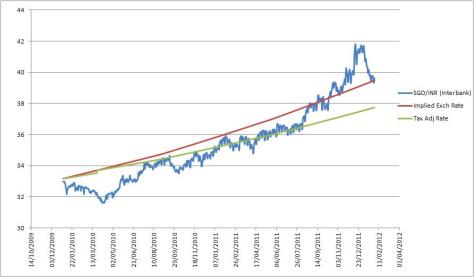
Here is the chart that gives the implied SGD INR rate based on Interest rates…Rule of the thumb is to convert whenever the Exchange rate stays above the Red line.

The current implied rate is 42.30Rs/$, which also is a strong support for the pair.

Having said that if Indian Govt follows reforms aggresively INR is bound to appreciate and the pair would breach the line downwards.


SGD-INR: Expected to maintain 38~40 range post Budget

The Indian rupee has moved within the expected range of 38.0 ~ 39.5 for the past few weeks as the Greek bailout unfolded and the Indian government presented the 2012 budget. As we near towards the end of first quarter its time to take stock of the old and new variables at play.

The Euro situation

It would be naive to say that the eurozone crisis is completely resolved. This is a temporary respite as policy makers try and reign in situations in Spain, Portugal and Italy which could spell bigger trouble. The general analyst consensus is for a weakening Euro. Any weakness in euro would be Rupee negative as it would impact exports

Interest rates in India

RBI paused the regime of interest rate hikes in its latest monetary policy statement. The tug here is between inflation and growth, the expectation is for RBI to start lowering rates in the second half of the year. Oil Prices as always would be a key here as a large part of foreign exchange outflows are used towards the oil bill. I am expecting rupee to move in the 48.5~51.5 range against USD for next few weeks.

One factor which could result in rupee weakness as a result of FII outflows is the new tax law that allows the Income tax department to charge corporations for past dealings.

Singapore Growth

The Singapore exports grew at a impressive 30% and another survey results highlighted Singapore economy to be most resilient of all Asian economies. This would attract investment flows into Singapore but the expectation is for SGD to stay around the 1.26 level against the USD.

Putting all these aspects together I am expecting INR to stay within the 38 ~ 40 range (widening it by 50p due to positives for SGD and INR negatives). The overall bias should still remain INR positive.

So my strategy would be convert at any rate above Rs.39.75 if you are looking to invest in India

SGD INR – What’s in store for 2012

2011, what a year it has been for the global markets and SGD INR has been a party to it. The pair started the year at 35.10 and finished at 40.74 a rise of 16%. However the pair has resumed the downtrend and is trading at 39.30 as I write – a drop of 4% from the year-end close.

Let me highlight how the past analysis has fared before delving into how the pair could move in 2012.

In the first post of the series on 23 April 2011 SGD INR – Has anything really changed the recommendation was to convert to INR and invest in deposits. The exchange rate was 35.50 on the date of writing and my recommendation was it could touch 36.5. this target was achieved on 30 May 2011.

The pair continued to move along the interest rate parity line and Tax Adjusted rate line for next 6 months before Rupee began its downslide in Sep 2011 due to weakening economy, uncontrolled inflation and financial turmoil in the global markets.

As Rupee slid from 48 to 54 against the US Dollar (USD) in the next three months its slide against the Singapore dollar was 37 to 41 – drop of 10% against either currencies.

When SGD breached 39 the prediction was for it to ride the momentum and cross 40 SGD Breaches 39 mark, Eyeing 40.

The prediction came true and Rupee went all the way to 41. In the post on 27th Nov 2011 the prediction was made for a pull back with pair ranging between 38.75 – 39.06 40 breached, What’s Next  which is on track as the pair is moving towards the 39 mark.

In the mean time a very interesting development happened as Reserve Bank of India (RBI) deregulated the NRE deposit rates to boost foreign currency supply in the market Now NRE Deposit yield 9.25%, and yes its Tax Free.

Having looked at all these factors here is my take for 2012 (stay tuned for updates every quarter, its very difficult to take a long term view in such volatile markets)

  • INR should strengthen against all currencies and SGD would be no exception.
  • On an Interest rate parity analysis SGD converted to INR and invested in an NRE account would grow to 43.25 in a years time at todays conversion rate of 39.5. The Rule I follow is to convert whenever the actual rate is above the implied rate line
  • With NRE deposits becoming tax free repatriating money in and out of India is easier
  • With Rupee strengthening the gains should be compounded for any investments made in INR

So unless you feel that SGD is headed towards a Rs45 mark in the next year investing in INR is sure to yield good return.


The Fall and Rise of Indian Rupee: 45 days to lows, 45 to recovery

What a roller coaster ride the past 3 months have been!

The rupee was trading at 48.6 against in the US dollar on 31st Oct 2011 and precipitated to touch 53.70 on 15 Dec 2011, a 10% drop. These were the historic lows for the currency and with RBI’s policy changes the rate as I write is 50 against the dollar with RBI reducing the CRR rate and rupee gaining 7% from the lows.

Inflation, falling growth numbers, uncertainity in Europe (which by the way still exists) and political roadblocks to financial reform were stated as the reasons for the weakness. All the reasons held resposible for rupees weakness are still there. Yes, inflation has eased a bit but thats pretty much the only change.

Among numerous suggestions aired to aid the rupee was for RBI to conduct open market purchases in style of Indonesian Central bank which burnt 8-9% of its foreign reserves to stabilise the rupiah. RBI however refrained and relaxed rules to make term deposits attractive for Non Residents Indians – and NRI’s did bring in money into India.

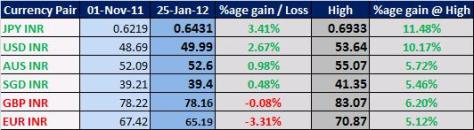
Lets see how has rupee faired against the other currencies in the past 90 days

Surprised – right!! You did not expect to see these numbers, neither did I.

Interestingly after 3 months the INR has returned back to almost where it started against all major currencies and even managed a small gain against GBP and EUR

Against the USD the losses are paltry 2.6% which is close to long term volatility number. JPY on the other hand does come up as unexpected top winner against the Rupee with gains of 3.4%, but the real numbers are the ones shown in the last column.

Extreme volatility is what the data screams – with rupee having lost over 10% against USD and JPY and over 5% against the other pairs.

Question now would be are we expecting another such bout of swings in the market?

I would say unlikely unless a sovereign default event happens.

and how about the direction of Rupee?

I am putting my money on a stable to moderately strong outlook. The RBI has held the repo rates, the CRR ratio has come down and with a weakened currency there should be a a bigger impetus on exports which should all be Rupee positive. However the political instability and global financial turmoil could more than negate any positive factors so 49 – 51 against the USD is what I would  be looking at till end of 1st quarter.

Save, Invest & Grow Your Wealth