Tag Archives: converting sgd to INR

SGD INR: How does 2013 look like?

4 more days for 2012 to end and its a perfect time to analyse what would 2013 be like for the currency pair.

SGD-INR started the year 2012 at 41.28 and trades at 44.80 at the time of writing, a gain of 8.5%. The pair touched a low of 38.88 and highs of 45.11 during the year a volatility of appx 12%.

Let me take stock of how the past analysis has fared before delving into how the pair could move in 2013.
Continue reading SGD INR: How does 2013 look like?

SGD INR: Implied Exchange Rates

Its been a while since I posted and SGD INR has gone on a see-saw ride since then :). People holding SGD against INR were taken aback the quick fall from 45 to 42 in a matter of days.

As always I stick to the strategy to convert and invest in Indian NRE accounts if you are happy with a 9% yield and have a time frame of atleast 1 year.

Here is the chart that gives the implied SGD INR rate based on Interest rates…Rule of the thumb is to convert whenever the Exchange rate stays above the Red line.

The current implied rate is 42.30Rs/$, which also is a strong support for the pair.

Having said that if Indian Govt follows reforms aggresively INR is bound to appreciate and the pair would breach the line downwards.


SGD-INR: Expected to maintain 38~40 range post Budget

The Indian rupee has moved within the expected range of 38.0 ~ 39.5 for the past few weeks as the Greek bailout unfolded and the Indian government presented the 2012 budget. As we near towards the end of first quarter its time to take stock of the old and new variables at play.

The Euro situation

It would be naive to say that the eurozone crisis is completely resolved. This is a temporary respite as policy makers try and reign in situations in Spain, Portugal and Italy which could spell bigger trouble. The general analyst consensus is for a weakening Euro. Any weakness in euro would be Rupee negative as it would impact exports

Interest rates in India

RBI paused the regime of interest rate hikes in its latest monetary policy statement. The tug here is between inflation and growth, the expectation is for RBI to start lowering rates in the second half of the year. Oil Prices as always would be a key here as a large part of foreign exchange outflows are used towards the oil bill. I am expecting rupee to move in the 48.5~51.5 range against USD for next few weeks.

One factor which could result in rupee weakness as a result of FII outflows is the new tax law that allows the Income tax department to charge corporations for past dealings.

Singapore Growth

The Singapore exports grew at a impressive 30% and another survey results highlighted Singapore economy to be most resilient of all Asian economies. This would attract investment flows into Singapore but the expectation is for SGD to stay around the 1.26 level against the USD.

Putting all these aspects together I am expecting INR to stay within the 38 ~ 40 range (widening it by 50p due to positives for SGD and INR negatives). The overall bias should still remain INR positive.

So my strategy would be convert at any rate above Rs.39.75 if you are looking to invest in India

The Fall and Rise of Indian Rupee: 45 days to lows, 45 to recovery

What a roller coaster ride the past 3 months have been!

The rupee was trading at 48.6 against in the US dollar on 31st Oct 2011 and precipitated to touch 53.70 on 15 Dec 2011, a 10% drop. These were the historic lows for the currency and with RBI’s policy changes the rate as I write is 50 against the dollar with RBI reducing the CRR rate and rupee gaining 7% from the lows.

Inflation, falling growth numbers, uncertainity in Europe (which by the way still exists) and political roadblocks to financial reform were stated as the reasons for the weakness. All the reasons held resposible for rupees weakness are still there. Yes, inflation has eased a bit but thats pretty much the only change.

Among numerous suggestions aired to aid the rupee was for RBI to conduct open market purchases in style of Indonesian Central bank which burnt 8-9% of its foreign reserves to stabilise the rupiah. RBI however refrained and relaxed rules to make term deposits attractive for Non Residents Indians – and NRI’s did bring in money into India.

Lets see how has rupee faired against the other currencies in the past 90 days
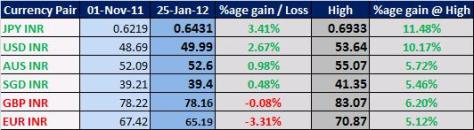
Surprised – right!! You did not expect to see these numbers, neither did I.

Interestingly after 3 months the INR has returned back to almost where it started against all major currencies and even managed a small gain against GBP and EUR

Against the USD the losses are paltry 2.6% which is close to long term volatility number. JPY on the other hand does come up as unexpected top winner against the Rupee with gains of 3.4%, but the real numbers are the ones shown in the last column.

Extreme volatility is what the data screams – with rupee having lost over 10% against USD and JPY and over 5% against the other pairs.

Question now would be are we expecting another such bout of swings in the market?

I would say unlikely unless a sovereign default event happens.

and how about the direction of Rupee?

I am putting my money on a stable to moderately strong outlook. The RBI has held the repo rates, the CRR ratio has come down and with a weakened currency there should be a a bigger impetus on exports which should all be Rupee positive. However the political instability and global financial turmoil could more than negate any positive factors so 49 – 51 against the USD is what I would  be looking at till end of 1st quarter.

Forty Breached, What’s Next??

SGD finally breached the 40 mark against the INR and as anticipated in mid Oct all that was needed was some more chaos in the global financial markets and a move of INR to 52 against the USD and SGD claiming the 1.30 mark. Lots of movement – right?

So the obvious question which would come to mind is where is the pair headed next? Can it stay above the 40 mark? Can it march towards the 45 territory? or is it slated to drop back to 36-38 territory?

INR quickly precipitating to 52.7 mark and RBI not intervening was a surprise, people eagerly waited for an indication from the RBI governor and it finally came in the last week.

In Singapore on the other side  the inflation quickened pace predominantly attributed to weaker SGD but it did help exports.

Now the stage is set for some pullback – RBI governor relaxed rules on how much money the Indian companies could borrow in foreign markets and also increased the interest rates on the NRI accounts. Both the measures should help strengthen the Rupee as more Foreign money flows into India. The Interest Rates are still attractive @ 10% and make the deposits in India a good investment.

MAS on the other hand might let the SGD stay against the current levels to keep growth intact.

I am expecting the INR to slowly ease back to the 50 mark against the USD and SGD to hover in the 1.28 ~ 1.30 range with occasional bouts of spikes to 1.32/1.33 mark.

This should make the SGD INR pair volatile with base rate around 38.75 ~ 39.06 with occasional drops to 37.5.

Yes I am expecting a pull back!

There is an odd chance of INR moving to 55 against the USD if Italy defaults or some odd event happens in Europe. The key here would be the price of Oil for RBI, if the price falls substantially – RBI would not intervene in the market even if the rupee went all the way to 55, but if the current rates of 90$+ continues then RBI would be left with no choice but to sell some dollars and reign in the fuel price fuelled inflation

SGD breaches the Rs.39 mark, Eyeing Rs.40!!

SGD breached the Rs.39 mark in the interbank market today. Its been a volatile past few days with swings of around 5% with a downside move from 38.4 to 37.25 (3% downside) and then back up at 39.05 (upside of 4.9%).

The key events to have taken place in the plast few days have been a depretiation of SGD to 1.30 from the highs of 1.20 against the USD before the MAS policy meeting and then swing back to 1.26. The reason for the downmove was a possibility of MAS reversing its stand on strengthening SGD. However MAS indicated that it would allows gradual appreciation of SGD against the undisclosed basket of currencies making the slope of the curve less steep.
On the other side INR depreciated to 49.2 from the 45 mark – thanks to the undecisiveness in the global markets.

An obvious question that comes to mind is that can SGD touch the Rs.40 mark – I would say quite likely. All that needs to happen for the move to happen is some more chaos in the global markets. A weakening of INR to 52 against USD and SGD to 1.30 would result in a Rs.40 mark which is a 2.5% move from here.

Alternatively SGD could move to 1.25 and INR to 50 to get the same result.

But for either scenarios to play out there has to be increased uncertainity in the global markets. I would say hold on to SGD , if you already have, for next 2 weeks – you just might get a Rs.40 conversion.